Oves meae vocem meam audiunt: Mary and the Shepherd who knows His sheep
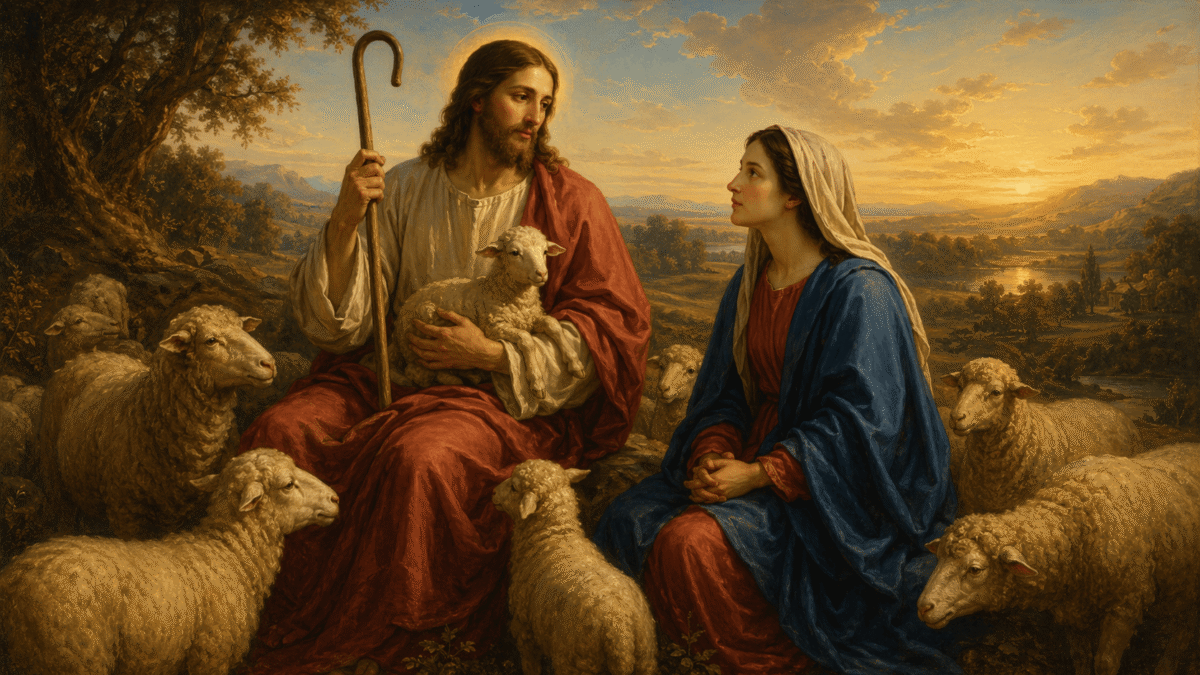
Oves meae vocem meam audiunt, et ego cognosco eas, et sequuntur me.
Jn 10:27
“My sheep hear my voice. I know them, and they follow me”. Jn 10 presents Jesus as the Good Shepherd in one of the richest pastoral images in the whole New Testament. The Shepherd who lays down His life for the sheep, who knows them by name, whose voice the sheep recognize, this shepherd reveals the intimacy of the mutual knowledge between the Son and His own. Mariology finds in this image a privileged place: Mary is, in the tradition, the sheep who most deeply “heard the voice” of the Shepherd and most faithfully followed Him.
I. The Good Shepherd: structure and theological horizon of Jn 10
Jn 10 is organized around two complementary images: the Shepherd and the Gate. Jesus is at once the Shepherd who leads the sheep (Jn 10:11-18) and the Gate through which the sheep enter (Jn 10:7-10). The combination of the two images is deliberate: the same Jesus who protects and guides is also the only access to life. “I came that they may have life and have it in abundance” (Jn 10:10), this promise defines the goal of the Good Shepherd’s mission.
The contrast with the “hired hand” and with the “thief and robber” (Jn 10:1, 12) is revealing. The hired hand flees when the wolf appears: he does not lay down his life for the sheep because they are not his own. The true Shepherd remains: “The Good Shepherd lays down his life for his sheep” (Jn 10:11). This “laying down of life” (tithênai tên psychên) is the gesture of utmost self-giving, which John associates with the voluntary death of Jesus on the Cross (cf. Jn 15:13). The Good Shepherd is recognizable precisely by this total self-giving.
The mutual “knowledge” between the Shepherd and the sheep, “I know my sheep and my sheep know me” (Jn 10:14), is more than an external recognition. The verb ginoskein in John has a Semitic depth: it is the knowledge of a personal relationship, of an intimate involvement that engages the whole person. This “knowledge” finds its foundation in intra-Trinitarian knowledge: “as the Father knows me and I know the Father” (Jn 10:15). The knowledge that unites the Shepherd to the sheep is a participation in the knowledge that unites the Son to the Father.
The eschatological promise of Jn 10:27-28 gives the pastoral theme a dimension of eternity: “I give them eternal life and they will never perish, and no one will snatch them out of my hand”. The Shepherd’s sheep are not merely protected in the present: they have an absolute eschatological security. The “hand” of the Father and the “hand” of the Son (Jn 10:28-29) form an invulnerable shelter where the sheep rest forever.
II. Mary, the sheep who “heard the voice” of the Shepherd
Jn 10:27 has three verbs in the present tense, “hear”, “know”, “follow”, which describe a permanent and living relationship. The sheep of the Good Shepherd is not an occasional follower: she is someone whose habitual state is to hear the voice of the Shepherd and to follow Him. This description finds in Mary its most perfect realization: she who “kept and pondered” (Lk 2:19, 51) every word and every event related to her Son is the sheep who most deeply “heard the voice” of the Shepherd.
The patristic tradition identified in Mary the model of contemplative prayer: not vocal or liturgical prayer, but the silent listening that lets the voice of God penetrate deep into the heart. The Lucan scene where Mary chooses “the better part” by sitting at the feet of Jesus (Lk 10:42), although it concerns Martha and Mary of Bethany, not the Mother of Jesus, was applied allegorically to Mary of Nazareth: she who all her life was the one who chose to listen rather than scatter herself in activity.
The Magnificat (Lk 1:46-55) reveals a woman who deeply “heard” the Scriptures of Israel and recognizes them as fulfilled in her. Her words are woven from allusions to Psalm 113, to the canticle of Hannah (1Sam 2:1-10), to the promise to Abraham (Gen 12:1-3). Mary does not improvise an original canticle: she recognizes the voice of the Shepherd in the words that Israel received over the centuries, and responds with a confession that is at once personal and communal.
The paschal dimension of this faithful sheep is manifested most clearly on Calvary. Jn 19:25-27 places Mary beside the Cross: she who followed the Shepherd along the way of the wedding at Cana, through the Passover pilgrimages to Jerusalem (cf. Lk 2:41), through the public ministry (cf. Jn 2; Mk 3:21-35), remains also at the moment of total abandonment. The sheep of human shepherds flee when the wolf attacks. The sheep of the Good Shepherd remains beside Him precisely when He “lays down his life for the sheep”.
III. “I have other sheep”: Mary and the catholicity of the flock
Jn 10:16: “I have other sheep that are not of this fold. I must bring them also, and they will hear my voice. And there will be one flock and one Shepherd”. This affirmation, which opens the mission of the Shepherd beyond Israel, is the theological basis of the catholicity of the Church. The “one flock” that Jesus wills to gather is not limited by the walls of any particular community: it includes “all the nations” (Mt 28:19), all those who hear the voice of the Good Shepherd.
Mary, in the mariological tradition, occupies a singular place in this catholicity. As Mater Ecclesiae and as Mediatrix, she stands at the center of the process by which the Shepherd gathers the one flock. Her motherhood is neither ethnic nor geographical, it is universal. The beloved disciple to whom Jesus entrusts her (Jn 19:26-27) represents all redeemed humanity: every one of the faithful of every time and place is entrusted to the maternal care of Mary.
The great Marian apparitions, Guadalupe (1531), Lourdes (1858), Fátima (1917), were historically moments of gathering and of renewal of the flock. Not by coincidence, each of these apparitions had as its immediate and measurable effect a mobilization of communities of faith, a renewal of prayer and of the sacraments, an intensification of the spiritual life. Mary, as helper of the Good Shepherd, gathers the scattered sheep and leads them back to the fold.
The ecumenical dimension of this catholicity is increasingly recognized. Christian communities separated from Rome frequently share a veneration of Mary, even if with different theological expressions, as an expression of the universal vocation of the Good Shepherd. The ecumenical document of the Groupe des Dombes (Marie dans le dessein de Dieu et la communion des saints, 1998) recognized that Mariology can be a point of ecumenical convergence precisely because the figure of Mary points to Christ, the one Shepherd.
IV. “My hand and the hand of the Father”: eschatological security and the Assumption of Mary
Jn 10:28-29: “No one will snatch them out of my hand. My Father, who has given them to me, is greater than all, and no one can snatch them out of the Father’s hand”. This promise of absolute eschatological security, “the hand of the Son” and “the hand of the Father”, finds in Mary its fullest and most visible realization: the Assumption.
The dogmatic definition of the Assumption (Pius XII, Munificentissimus Deus, 1950) affirms that Mary “having completed the course of her earthly life, was assumed body and soul into the glory of Heaven”. This careful formulation does not pronounce on the modalities, whether Mary died or not, but affirms the fact: Mary is entirely in the “hand of the Father and of the Son”, entirely safe from corruption and from definitive death.
The Assumption is thus the ultimate confirmation of the promise of the Good Shepherd: “no one will snatch them out of my hand”. Mary, who was the most faithful sheep, the closest to the Shepherd, who never fled even when the wolf attacked, received the definitive fulfillment of the promise. She is now in the eternal fold, where there is no longer any threat of the wolf, where the Shepherd guides His sheep “to springs of living water” (Rev 7:17).
The icon of the Dormition (Koimesis) in the Orthodox tradition shows Mary lying in peace, surrounded by the Apostles, while Christ, the Good Shepherd, holds her soul represented as a child. The image captures theologically what is essential: Mary, the faithful sheep, rests in the hand of the Shepherd who knew her and led her throughout her whole life. The promise of Jn 10:28 has a face, a name, a history: her name is Mary of Nazareth.
Mary, the sheep who most deeply heard the voice of the Good Shepherd and most faithfully followed Him to the Cross, is the image of the Church that rests secure in the hands of the Son and of the Father.
References
- John Paul II, Redemptoris Mater, nos. 20-24 (1987).
- Pius XII, Munificentissimus Deus (1950).
- Groupe des Dombes, Marie dans le dessein de Dieu (1998).
- C. Spicq, Agapè dans le Nouveau Testament, vol. III.
- X. Léon-Dufour, Lecture de l’Évangile selon Jean, vol. II (1990).
Postgraduate Program in Mariology
Would you like to deepen your formation in Mariology? Discover the Postgraduate Program in Mariology of Locus Mariologicus – an academic formation that unites theological rigor, spiritual life, and the living tradition of the Church.
Would you like to study Mariology seriously?
This article is born of the works in the library of Locus Mariologicus. The Postgraduate Program in Mariology takes you to the same source, with academic guidance: Scripture, the Fathers of the Church, and the Magisterium, from the first dogma to contemporary questions.




Responses