Pacem relinquo vobis: Mary and the peace the world cannot give
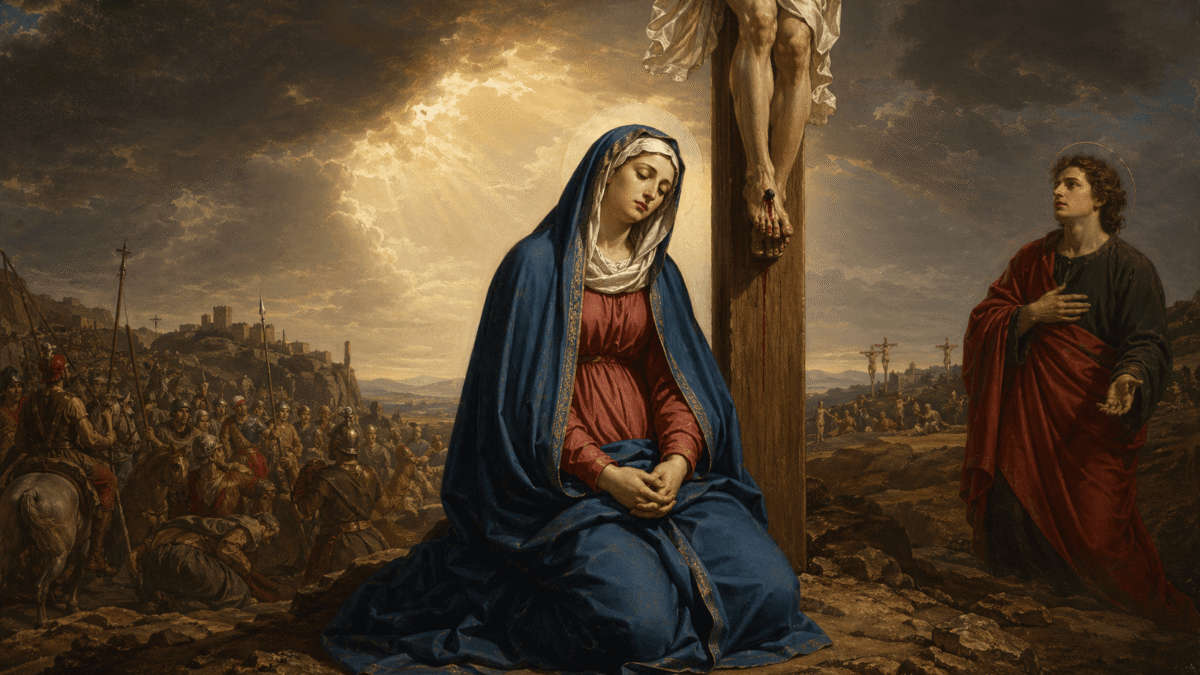
Pacem relinquo vobis, pacem meam do vobis: non quomodo mundus dat, ego do vobis.
Jn 14:27
“Peace I leave with you. My peace I give to you: not as the world gives it do I give it to you”. Jn 14:27 is one of the densest affirmations of Jesus’ farewell discourse: He who is about to be arrested, tried and crucified promises “peace”. And not just any peace, His peace, which is of a different nature from the one the world can offer. This distinction, “not as the world gives it”, is the Mariological key to the text: Mary, who remained beside the Cross in the apparent absence of all worldly peace, is the icon of the peace that the world can neither give nor take away.
I. The peace of Jesus and the peace of the world: two opposed logics
The Hebrew term shalom that underlies the “peace” of which Jesus speaks is much richer than the simple absence of conflict. Shalom is fullness, integrity, total well-being, the condition of a person or of a community that is in harmony with God, with itself and with others. The Jewish liturgical greeting shalom aleichem (“peace upon you”) is a wish for integral fullness, not merely for exterior tranquility.
Jesus distinguishes His peace from the peace “that the world gives”. The peace the world offers is contingent: it depends on favorable exterior circumstances, the absence of war, health, prosperity, harmonious relationships. When circumstances change, this peace disappears. The peace of Jesus is of another nature: it does not depend on exterior circumstances but on an interior relationship with the Son that “no tribulation, nor distress, nor persecution” can break (cf. Rom 8:35).
The Christian mystical tradition identified this peace of Jesus with what Saint John of the Cross called “serenity” (quietude) and Saint Ignatius of Loyola called “spiritual consolation”: a peace that coexists with sorrow, that is neither insensibility nor anesthesia, but the profound stability of one who is anchored in God beyond affective fluctuations. This peace is the fruit of the Spirit (Gal 5:22), not a human achievement, but a divine gift that is received in the measure in which we open ourselves to the Spirit.
The distinction between “worldly” peace and the peace “of Jesus” has a social and political dimension that tradition has frequently neglected. The “Pax Romana”, the imperial peace that Rome imposed by force, is exactly the “peace that the world gives”: contingent, dependent on the power of the strongest, capable of turning into civil war when the balance of forces shifts. The peace of Jesus, on the contrary, does not require domination; it requires conversion: the interior transformation that aligns the human will with the will of God.
II. Mary “Stabat”: the peace that remains in sorrow
Jn 19:25: “Standing by the Cross of Jesus was His Mother”. The Greek verb is histêken, “was standing”, stabat in Latin. This detail, which might seem minor, has been contemplated by tradition as a theological symbol: Mary did not fall, did not flee, did not faint. She “was standing”, in the posture of the orant, in the posture of the believer who remains firm before the mystery that surpasses all human understanding.
This “standing” of Mary is neither stoicism nor insensibility. The sword of Simeon that Lk 2:35 had announced was being fulfilled: Mary suffered in a real and profound way. But suffering did not destroy her. She possessed a peace that the world could neither give nor take away: the peace of knowing that the Son was in the hands of the Father, even though that “knowing” was now pure faith, without sensible confirmation, without exterior evidence.
The Stabat Mater, the celebrated medieval hymn attributed to Jacopone da Todi, contemplates this mystery with a beauty that over the centuries has formed Christian spirituality. “Stabat Mater dolorosa / iuxta Crucem lacrimosa”, standing, sorrowful, in tears, but standing. The combination of sorrow and firmness is the most perfect image of the peace of Jesus: not the peace that eliminates sorrow, but the peace that sustains within sorrow. This peace God alone can give, and Mary possessed it in a singular way.
The contemplative tradition identified in Mary “beside the Cross” the model of the “dark night of faith” of which Saint John of the Cross speaks. The night in which all sensible consolations withdraw, in which God seems absent, in which faith is sustained only by bare adherence to the word of Christ, this night has in Mary its most radical and most fruitful experience. She who remained “standing” when every sensible support disappeared is the model of every soul that passes through the nights of faith with the peace that Jesus promised.
III. “Let not your heart be troubled”: Mary and eschatological serenity
Jn 14:27 ends with an exhortation: “Let not your heart be troubled, neither let it be afraid”. The troubling of the heart (tarassesthô) is the habitual human response to threats and to uncertainty. Fear (deiliastô) is the response to the perception of danger. Jesus asks His disciples to resist these natural responses, not out of indifference to problems, but through the peace that He promises to give.
Mary, who received the news of the Annunciation with an initial troubling of heart (“on hearing these words she was troubled”, Lk 1:29) but who immediately responded with the fiat, lived throughout her life the process that Jesus describes: the transformation of that troubling into peace. She learned, over decades of life with the Son, not to “let her heart be troubled” by adverse circumstances, trusting in the word of the Son.
Mary’s serenity is not a natural temperament; it is a supernatural virtue. Tradition speaks of her “imperturbability” (ataraxia in Greek philosophical terminology, theologically reinterpreted) as a fruit of grace: not stoic indifference to events, but the profound rootedness in God that makes it possible to receive the storms of life without being destroyed by them. This serenity is precisely the “peace that Jesus gives”, the peace that “surpasses all understanding” (Phil 4:7).
Contemporary Marian spirituality, in particular that of Saint John Paul II, who had a very profound Marian devotion, explored this peace of Mary as an antidote to the “fear” that characterizes modern culture. John Paul II’s papal exhortation “Do not be afraid!” (Non abbiate paura!) echoed, consciously or not, the exhortation of Jesus in Jn 14:27, and had in Mary its spiritual support: he who carried with him the Totus Tuus coat of arms lived the peace that Jesus promised under the gaze of the Mother.
IV. “My peace”: the Prince of Peace and our Advocate
Is 9:5 announces the “Prince of Peace” (Sar Shalom) as one of the titles of the awaited Messiah. Jesus fulfills this title in a radical way: not by bringing peace through the force of arms but through the gift of His own life. His peace is the fruit of His death and resurrection: “the peace that Jesus gives” is the peace that comes from the reconciliation with the Father brought about by the Cross. The peace of Jn 14:27 is not separable from the paschal mystery; it is received only from the Risen One, from Him who passed through death and conquered it.
Mary, Regina Pacis, Queen of Peace, is a title that the Church attributed to Mary precisely in this context: she who stands beside the “Prince of Peace”, who took part in His paschal mystery in a singular way, is the Queen who distributes the peace of the Son to her spiritual children. This title gained a particular urgency in the twentieth century, when the two World Wars devastated Europe and the world: the apparitions of Fatima (1917), with their request for conversion and peace, were received as the cry of the Queen of Peace in a world at war.
Mary’s intercession for peace is not a pre-modern devotion irrelevant to the world today; it is a cry that every generation sends up anew as human conflicts perpetuate themselves. The Advocata nostra, our Advocate, of whom the Salve Regina speaks, intercedes permanently for the peace that the world cannot give to itself. And her intercession has the power of the one who lived “beside the Cross”, who knows the price of peace and who, for this reason, intercedes with the authority of the one who passed through Calvary.
Eschatological peace, the definitive shalom that the Kingdom of God will bring in its fullness, has in Mary its most perfect anticipation. She who was assumed body and soul into glory, she who is in the full presence of the “Prince of Peace”, already lives the peace for which the Church hopes. To contemplate Mary glorified is to anticipate the promised shalom. To invoke her intercession is to ask that the peace of the Son, which is different from the peace the world gives, may even now penetrate hearts and transfigure communities.
Mary, “standing” beside the Cross and Queen of Peace, is the image of the peace that Jesus promised, different from the peace the world gives, and the powerful intercessor for a world that needs that peace.
References
- John Paul II, Redemptoris Mater, n. 44-47 (1987).
- Second Vatican Council, Gaudium et Spes, n. 78 (1965).
- Saint John of the Cross, The Ascent of Mount Carmel, II, 1-3.
- X. Léon-Dufour, Lecture de l’Évangile selon Jean, vol. III (1993).
- A. Frossard, N’ayez pas peur! Dialogue avec Jean-Paul II (1982).
Postgraduate Program in Mariology
Would you like to deepen your formation in Mariology? Discover the Postgraduate Program in Mariology of Locus Mariologicus – an academic formation that unites theological rigor, spiritual life and the living tradition of the Church.
Would you like to study Mariology seriously?
This article is born of the works in the library of Locus Mariologicus. The Postgraduate Program in Mariology takes you to the same source, with academic guidance: Scripture, the Fathers of the Church and the Magisterium, from the first dogma to contemporary questions.




Responses