The mission of Mary: divine and universal motherhood

The mission of Mary: divine and universal motherhood
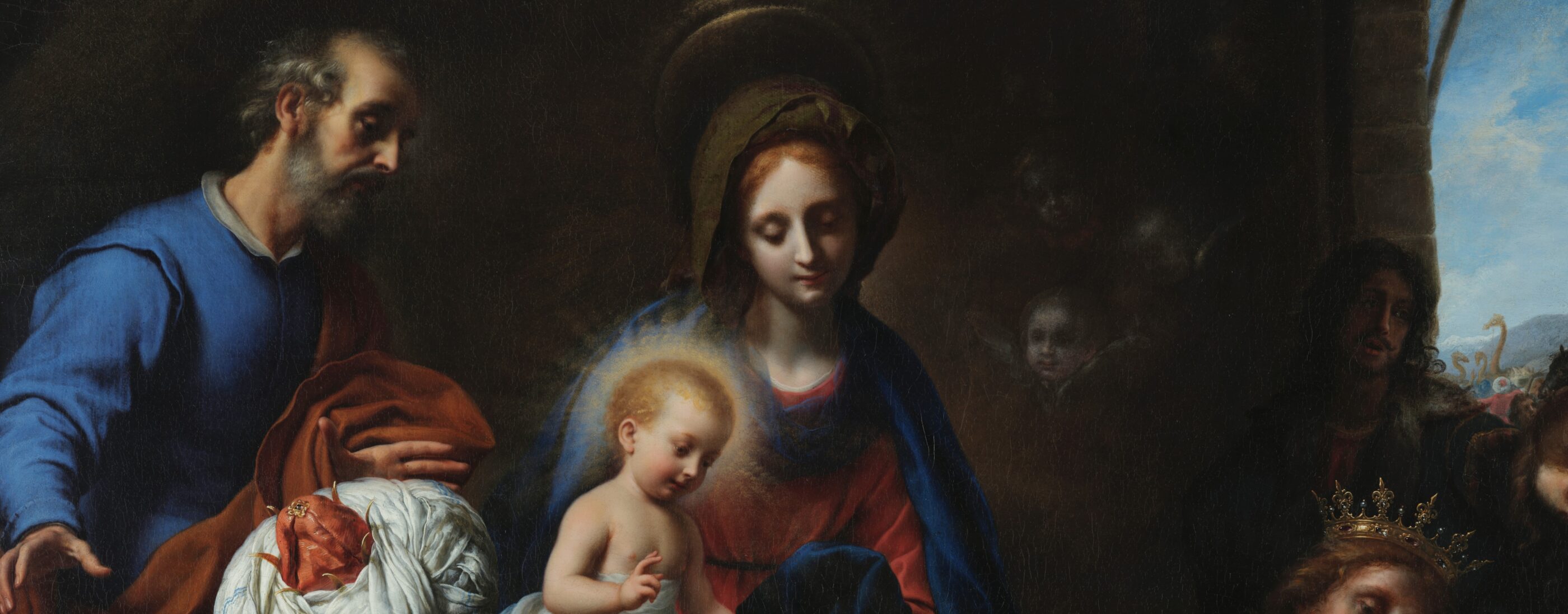
The divine election and vocation have as their content the motherhood of Mary, mother of that singular person who is Jesus. This motherhood represents the meaning of her historical-salvific mission and the point of arrival of her election and vocation. This motherhood goes beyond the individual person of Mary and attributes to her a communal role. In fact, her vocation makes of this young woman both the one who personifies the Jewish hope and the one who introduces, in the following of Christ, the new life of the Church.
Still according to the account of the Annunciation, it can be observed that it contains two different revelations which follow the angelic words of messianic joy. The first is the text of Lk 1:30-33, which recalls the fulfillment of the hope of Israel: the you will conceive (v. 31), proper to the life of a woman, is here linked to the hopes of Israel (vv. 32-33) so that her life as a woman is summed up around messianic events that are accomplished in dialogue between her freedom and that God before whom she found grace (v. 30).
The second revelation concerns the passage of Lk 1:35-38. It is introduced by a question from Mary, which aims to show how God is greater than any man. Here the feminine role of conceiving is transcended in order to give place to the Spirit, the true actor, (the one who acts), of this event. Mary is thus called to go beyond the human messianism proper to creation in order to open herself to the Spirit (v. 35), and this implies an inversion of the usual human logic (vv. 36-37). Hope always passes through a human involvement, but its result is no longer a simple human measure.
This creative action of the Spirit is accomplished in the birth of Jesus (Lk 2:1-7) and is revealed to the shepherds and to the wise men, who are reflected in the disturbance of Jerusalem. In the history of Mary, this transcendent work of the Spirit finds room both in these astonishing events and in the welcoming of the Word in order to meditate on it (Lk 2:19, 51), to assimilate it and to proclaim it in all its depth (Lk 1:51-53).
The mission that Mary is called to fulfill thus passes through the Word that penetrates hearts (Lk 2:35; Acts 2:37) and through the Spirit, through the Ruah and the dabar, the two hands of God. The Spirit enlightens and leads into the truth of the Word those who are not yet able to bear its weight (Jn 16:12; 14:17). From the Spirit comes the perception of the newness of the Word which only divine love can originate (Jn 14:26; 15:26; 16:13-14). Guided by the Spirit, Mary meditates on the Word until she finds in it the human space for its understanding and witness. Mary appears to us as the form, that is, as the model, the type of the Church. She is, within the Church, the form by which the Church completes herself as Bride in order to give herself to the Bridegroom.
Even more clearly, when we say that the Church is Marian, we mean that Mary is interiorized in the Church, to which she communicates her spirit.
This Marian reading of the Church requires some clarifications. It is not a matter of a simple transposition of the notion of the person of Mary to the Church, but of a rethinking of the bond of Mary with the Word and with the Spirit and of the way in which the Church is structured in them. Following Paul, it can be said that the bond of Christ with the Church lies in the fact that she is the body of Christ in the sense that she is a participation in and an extension of His life. This theological perspective will find its most incisive expression of the Church as continuous incarnation.
Christ is the one who sustains and animates the Church because His Spirit participates in her. It is necessary to take into account both the fact that Christ is the head of that Church which is His body, and the fact that the members of the Church are persons in themselves and, as such, cannot be dissolved into a communal personality. It is therefore necessary to go beyond a simple corporate personality, of a juridical nature, and to understand the Spirit as a force of communion which, by virtue of His trinitarian ancestry, places the faithful in deep communion with Christ and with His life, while at the same time respecting their singularity and distinction. As a force of communion, the Spirit mediates Himself in persons and thus makes them participants in His communion with the divine persons of the Father and of the Son and members of ecclesial communion.
In this context, the Marian reading of the Church appears truly profound. On the one hand, Mary is modeled according to that gift of self which is proper to the Son, while, on the other, she is modeled according to that unifying communion of many which is the Spirit. In this way, the gift of self of the Son reaches the fullness of the kingdom in the economy of salvation only when the Church emanates from herself by sharing in His Spirit. In Mary the Church, which the Spirit will build later in history, is present in an originating form, and as such real; for this reason we can define Mary as the normative subjectivity of the Church in her response as Bride to Christ.
The relationship of Mary with Christ passes through the Spirit because in the incarnation Mary did not cooperate immediately with her Son, at that beginning of the work of salvation, but did so only through the mediation of the Holy Spirit. The proper function of the Holy Spirit in the economy of salvation can be described as a collaboration in the redemptive work of the Son. The cooperation of Mary is above all a participation in the collaboration that the Holy Spirit renders to the redemptive work of the Son. Following the patristic pneumatological heritage, we can affirm that the personality of Mary is pneumatoform.
Christ and the Spirit appear to be active in Mary and are necessary for the life of the Church. Christ confers unity on the various members as parts of a whole, while the Spirit confers on this whole the characteristics proper to every personal life: memory and consciousness. In this way, the personality of the Church begins with Christ, lives by the Spirit, and finds its icon in Mary: in her the Spirit exercises a unique and singular function that leads her to make of her whole relationship with the Word, through the Spirit, the model of life for every Christian.
To deepen the reflection on the mission of Mary and her universal motherhood, consult the encyclical Redemptoris Mater by John Paul II, dedicated entirely to the maternal mission of Mary in the economy of salvation.
Deepen your studies: explore Mariology, Marian Theology, Marian apparitions, and the Postgraduate Program in Mariology.
Postgraduate Program in Mariology
Would you like to deepen your formation in Mariology? Discover the Postgraduate Program in Mariology of Locus Mariologicus – an academic formation that unites theological rigor, spiritual life, and the living tradition of the Church.
Would you like to study Mariology seriously?
This article is born from the works in the library of Locus Mariologicus. The Postgraduate Program in Mariology takes you to the same source, with academic guidance: Scripture, the Fathers of the Church, and the Magisterium, from the first dogma to contemporary questions.




Responses