The Rosary and the Bishops of Rome
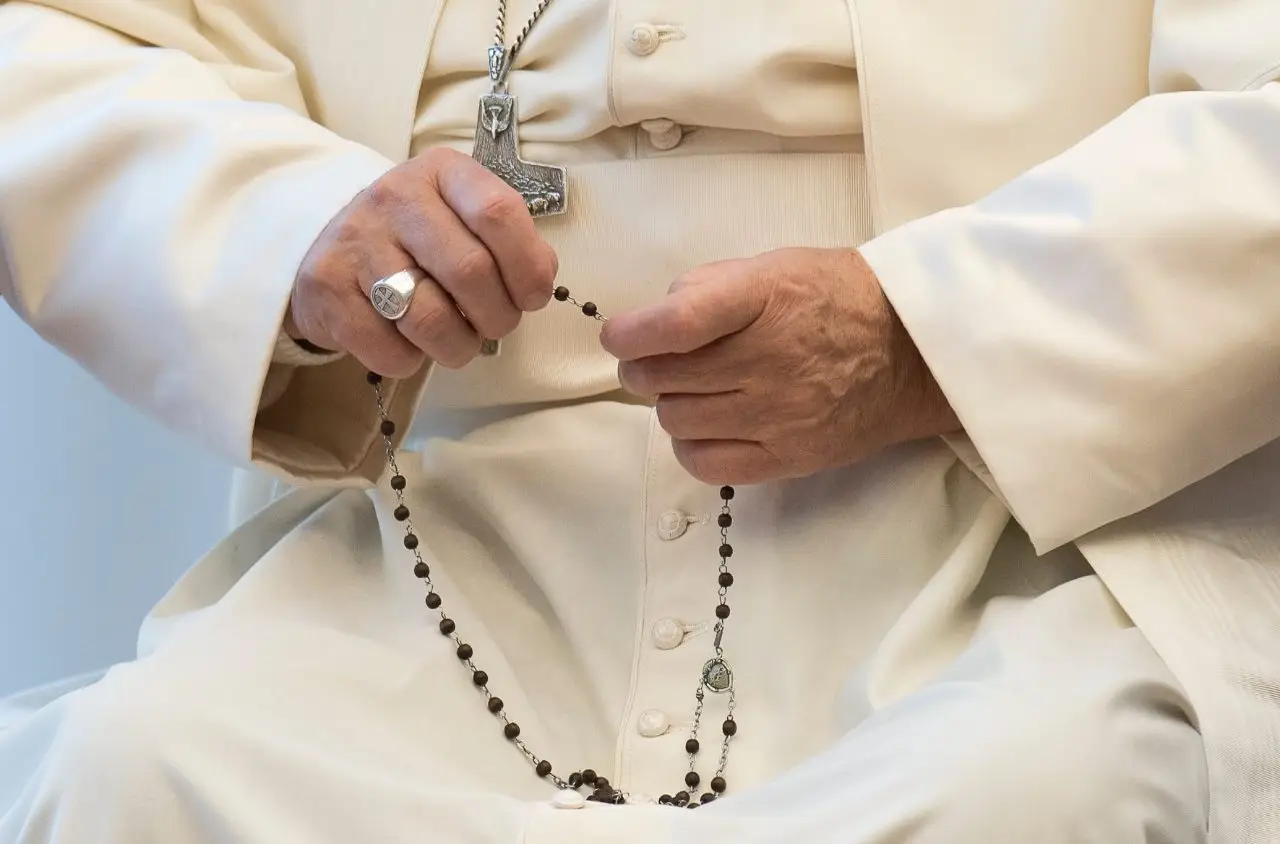
The Rosary of Mary and the Bishops of Rome: a papal tradition
The work carried out by the Bishops of Rome, both in the past and in the present, has been to promote and to encourage among the faithful the evangelical prayer of the Rosary, a prayer that knows well how to accompany the seasons of the life of the faithful. The appeal of Saint John Paul II, who invited all Christians (pastors, theologians, and laypeople) to take up again with confidence the Psalter of the Virgin, rediscovering it in the light of the revealed Word, in harmony with the liturgy of faith, in the context of daily existence (cf. RVM 43), is still timely.
Moreover, the prayer of the Rosary not only punctuates, in a prayerful and contemplative manner, the daily and ordinary existence of the Catholic faithful, but it is also recognized and experienced as a valuable help and comfort, as Pope Wojtyła himself taught, in the experience of pain and illness. Sacred Scripture, the foundational text of the Judeo-Christian faith, which must be understood in its Old and New Testament parts as “a single book, and this book is Christ” (Hugh of Saint Victor, Noah’s Ark, II,8), must be considered by the faithful as the great book of the “history” of God and, in God, of humanity.
It is, at the same time, a holy and true account of the merciful/maternal gaze of God upon the world: “The eyes of the Lord range over the whole earth” (Zech 4:10). An attentive gaze, capable of penetrating the most secret places (cf. Sir 23:19). Those paternal/maternal eyes, attentive to the different realities and needs of the man and the woman who are infinitely loved, are ready to perceive and to wipe away the tears of suffering, which God Himself gathers tenderly in a wineskin (cf. Ps 56:9). They take delight in the spiritual poverty of the humble and the poor, like that of Hannah and Mary of Nazareth. The compassionate gaze and the tender and generous heart of the One and Triune God have always accompanied the history of humanity and of each of its members. And this the Mother and Handmaid of the Lord experienced: she was favored by that gaze, and for this reason she points to it in her universal motherhood!
Moreover, the Mother of the Lord and of the Church, who on earth knew suffering and pain, and not only because of her Son and His saving work, has always been invoked as Salus infirmorum (Health of the Sick), being solicitous and full of tenderness in coming to the aid of her children marked by suffering. For this reason, Christian communities, the sick, and those who find themselves in pain invoke her with the recitation of the Rosary, so that, through her intercession, they may recover health of body and peace of heart, consolation and hope of spirit. In shrines, where the recitation of the Rosary is more fervent, one finds many testimonies of the immense trust that those who suffer place in the Mother of Christ, because something new has happened in their lives: conversion or healing.
It is not surprising, therefore, that the Popes over the centuries, both in times of difficulty and in times of social and ecclesial serenity, have held the Marian Rosary in great esteem, constantly recommending it to the attention and the practice of the Christian people, inviting them to recite it with the simplicity and the fervor of the humble, the afflicted, and the trusting. Nor is it by chance that the Bishops of Rome of the twentieth century, especially Pope John Paul II, proposed with conviction “to all Christian families the prayer of the Rosary, so that they may savor the beauty of stopping together to meditate with Mary on the joyful, sorrowful, and glorious mysteries of our Redemption, and thus sanctify both the happy and the difficult moments of daily life.”
On the occasion of his pilgrimage for the 150th anniversary of the apparitions at the famous Shrine of Lourdes, on September 14 and 15, 2008, Pope Benedict XVI forcefully recalled how the French shrine (and this also holds for the countless other “houses of Mary,” which are the shrines dedicated to her) is, by its own vocation, a place of intense and genuine encounter of prayer with God and, at the same time, of concrete human fraternity/sorority in the company of the Mother of Jesus. Indeed: “The primary vocation of the Shrine of Lourdes [and of all Marian shrines] is to be a place of encounter with God in prayer and a place of service to our brothers and sisters, especially in the welcome given to the sick, to the poor, and to all persons who suffer. In this place, Mary appears to us as the mother ever available to the needs of her children. Through the light that streams from her face, it is the mercy of God that shines through. Let us allow ourselves to be touched by her gaze: it tells us that we are all loved by God and never abandoned by Him! Mary comes to remind us that prayer, intense and humble, trusting and persevering, must occupy a central place in our Christian life. Prayer is indispensable in order to receive the strength of Christ. ‘Those who pray are not wasting their time, even if the situation has all the characteristics of an emergency and seems to demand action alone’ (Deus caritas est 36). Letting oneself be absorbed by activities runs the risk of causing prayer to lose its Christian specificity and its true effectiveness.”
If, on the one hand, prayer is a theophanic experience, on the other hand it is also an anthropophany, that is, a manifestation of man. In prayer-communion, the human being experiences the splendor, the beauty, and the goodness of God. And the Thrice Holy One, in His unthinkable and exemplary humility and in the delight that characterizes Him, has an experience of the human being, filling him with His love and granting him a transfiguring experience, in imitation of the theophanies of the Old Testament, but above all of the Christophany of Tabor (cf. Lk 9:28-36), where the apostle Peter, enraptured and bewildered by so much holy and divine beauty, exclaimed: “It is good for us to be here!” (Lk 9:33 [cf. Lk 9:28-36]. Cf. Mk 9:2-13. Mt 17:1-9).
The world today suffers from the shocking ugliness and brutality inflicted upon humanity and upon creation. It is necessary to recover and to stabilize the ecology of the heart and of the mind in order to seek the lost beauty, which can always be pursued: an integral ecology that the Beautiful and Holy Son of God is able to radiate, to indicate, and to restore in the human being and in the world, and of which the Tota Pulchra (All Beautiful) is a wholesome and splendid icon. It is not by chance that, along the same lines as the transfiguring experience of Tabor, every true and providential apparition/Mariophany — providential because it is made such by the design of God — is, at the same time, a highly aesthetic experience: there one finds an uncontaminated reality, a Most Beautiful Person who lovingly calls us to live a beautiful and good life. For this reason, on our theological journey toward the Thrice Holy One, through the diaconia of the Tota Pulchra, whether in prayer, in contemplation, or in the mystical and theological experience of the Mystery, we are led to have, albeit with the due differences, the experience of the Apostles on Tabor, with Mary, the mother of Jesus (Acts 1:14)!
The transcendent and precious beauty of the Son of God invites the disciple, man or woman, to “ascend” and to let himself or herself be transformed in the aura of divine holiness, in order to be completely transformed into a creature with “a new spirit and a new heart.” In this regard, the Japanese theologian Luca M. Ritsuko Oka writes: “The transformation of Mary’s heart, that is, of her whole bodily-spiritual person, was completed in the full participation in the glorified body of Christ. Mary ‘lives with Jesus completely transfigured’ and ‘in her glorified body, together with the risen Christ, part of creation has attained the full plenitude of its beauty’ (Francis, Laudato si’, 241).”
Concerning the theological fruits that flow from the prayer/contemplation of the Rosary, the address on popular piety at the end of the recitation of the Rosary in Saint Peter’s Square on May 31, 2013, is paradigmatic: there, describing the attitude of the Mother of Jesus as the evangelist Luke narrated it for us in the episode of the visit to Elizabeth, the Pontiff sums it up in three words: listening, decision, action. A triad that, moreover, constitutes the very purpose of the prayer of the Rosary: with Mary one contemplates the mystery of Jesus, in order to learn to listen, to decide, and to act for the Kingdom of God.
A triad that, in the following year, on May 31, 2014, the same pontiff would sum up in the Marian title of “Our Lady of Readiness.” For Pope Francis, therefore, the Rosary is a prayer that trains one to “be ready”: ready to hear the Word of life. Ready for the decision or for the fundamental option for the God of Christ. Ready for the action and the service of the Evangelii gaudium, after the example of the Virgin of Nazareth, an exemplary woman of faith, a woman loved by God, who learned mercy from God as listening, as decision, as her action in the present of the Church and of the world. Finally, Pope Francis affirms something not secondary: “There is one reality: Mary always leads us to Jesus. She is a woman of faith, a true believer.”
Deepen your studies: explore Mariology, Marian Theology, Marian apparitions, and the Postgraduate Program in Mariology.
To deepen Marian devotion through the Rosary, consult the Apostolic Exhortation Marialis Cultus of Pope Paul VI.
Postgraduate Program in Mariology
Would you like to deepen your formation in Mariology? Discover the Postgraduate Program in Mariology of Locus Mariologicus – an academic formation that unites theological rigor, spiritual life, and the living tradition of the Church.
Learn to pray the Rosary in our guide: How to Pray the Rosary, Step by Step.
Would you like to study Mariology seriously?
This article is born of the works in the library of Locus Mariologicus. The Postgraduate Program in Mariology brings you to the same source, with academic guidance: Scripture, the Fathers of the Church, and the Magisterium, from the first dogma to contemporary questions.
Responses