The Protoevangelium of James
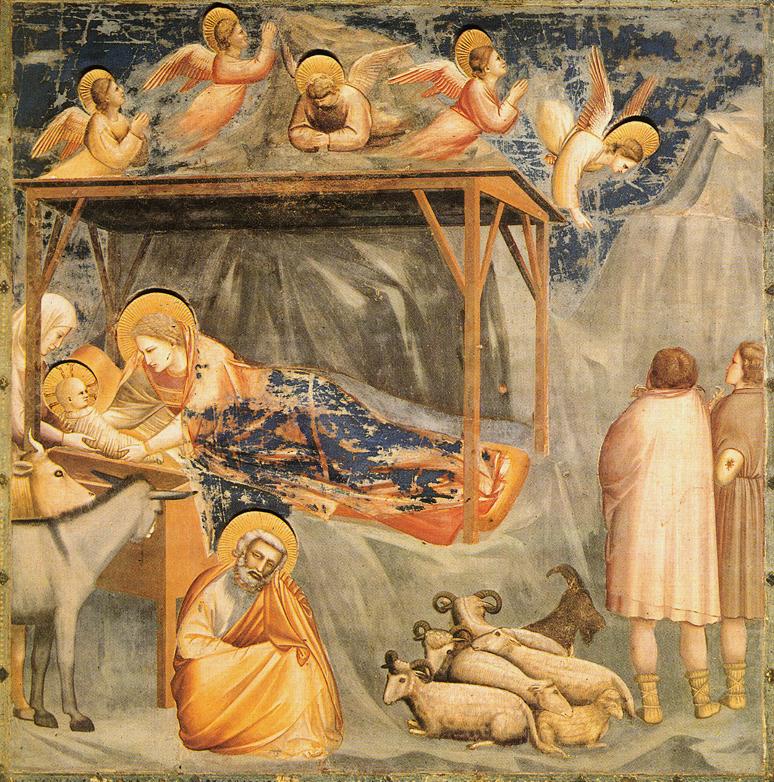
The Protoevangelium of James, or “Nativity of Mary,” is one of the most significant apocryphal books of Christian antiquity.

It is a very famous writing, much read and much copied, for we possess no fewer than 150 manuscripts. The editio princeps of the Greek text is from 1564, but before that, in 1552, the Jesuit Guillaume Postel had already published a Latin version of the text. A fundamental edition is that of C. Tischendorf, from 1853, which used 18 manuscripts. It may be supposed that the work, in its present form, goes back to the period around the year 200. Scholars have suggested as places of origin Egypt, because of the affinity of its language with Coptic, according to Erbetta, or Syria or Egypt, according to Norelli. See also the version of the Bodmer papyrus proposed on another page of this collection.
Nativity of Mary, Holy Mother of God and most glorious Mother of Jesus Christ
1, 1 According to the histories of the twelve tribes of Israel, there was a certain Joachim, a very rich man. He made his offerings twofold, saying: “What is superfluous for me shall be for all the people, and what is due for the remission of my sins shall be for the Lord, as expiation on my behalf.”
1, 2 The great day of the Lord came, and the children of Israel were presenting their offerings. Reuben stood before him and said: “It is not for you to offer your offerings first, for you have had no offspring in Israel.”
1, 3 Joachim was deeply grieved and went to the records of the twelve tribes of Israel, saying: “I want to consult the records of the twelve tribes of Israel to see whether I am the only one who has had no posterity in Israel.” He searched and found that all the righteous in Israel had had posterity. Then he remembered the patriarch Abraham, to whom, in his last day, God had given a son, Isaac.
1, 4 Joachim was greatly grieved and no longer let himself be seen by his wife. He withdrew into the wilderness, pitched his tent there, and fasted forty days and forty nights, saying to himself: “I will not go down either for food or for drink, until the Lord visits me. My prayer shall be my food and drink.”
2, 1 But his wife raised two lamentations and poured out two laments, saying: “I will bewail my widowhood and I will bewail my barrenness.”
2, 2 The great day of the Lord came, and Judith, her maidservant, said to her: “How long will you humble your soul? Behold, the great day of the Lord has come, and it is not lawful for you to mourn. Take rather this headband, which the mistress of the work gave me. It is not lawful for me to wear it, because I am a servant and because it bears a royal mark.”
2, 3 But Anna answered: “Get away from me. I do not do such things. God has greatly humbled me. Perhaps some wicked man gave it to you, and you have come to make me share in your sin.” Judith replied: “What curse could I lay upon you, that the Lord, who made your womb, should give you no fruit in Israel?” Anna was greatly distressed.
2, 4 She took off her mourning garments, washed her head, put on her bridal garments, and about the ninth hour went down to walk in the garden. Seeing a laurel tree, she sat down at its foot and entreated the Lord, saying: “O God of our fathers, bless me and hear my prayer, as you blessed the womb of Sarah, giving her a son, Isaac.”
3, 1 Gazing up to heaven, she saw a nest of sparrows in the laurel tree, and she composed within herself a lamentation, saying: “Woe is me. Who begot me? What womb brought me forth? I have become a curse before the children of Israel, I have been insulted and cast out with scorn from the temple of the Lord.
3, 2 Woe is me. To what am I likened? I am not likened to the birds of heaven, for even the birds of heaven are fruitful before you, Lord. Woe is me. To what am I likened? I am not likened to the beasts of the earth, for even the beasts of the earth are fruitful before you, Lord. Woe is me. To what am I likened?
3, 3 I am not likened to these waters, for even these waters are fruitful before you, O Lord. Woe is me. To what am I likened? Assuredly I am not likened to this earth, for even this earth brings forth its fruits according to the seasons and blesses you, O Lord.”
4, 1 Behold, an angel of the Lord appeared to her, saying: “Anna, Anna. The Lord has heard your prayer. You shall conceive and give birth. Your offspring shall be spoken of in all the earth.” Anna answered: “As the Lord my God lives, if I give birth, whether to a boy or to a girl, I will offer it as a votive offering to the Lord my God, and it shall serve him all the days of its life.”
4, 2 And behold, two angels came to say to her: “Your husband Joachim is coming back with his flocks.” An angel of the Lord had come down to him to say: “Joachim, Joachim. The Lord has heard your persistent prayer. Go down from here. Behold, Anna your wife shall conceive in her womb.”
4, 3 Joachim went down and sent for his shepherds, saying: “Bring me ten lambs without spot or blemish; they shall be for the Lord my God. Bring me also twelve tender calves; they shall be for the priests and for the council of elders. And a hundred kids as well for all the people.”
4, 4 And behold, Joachim came with his flocks. Anna was standing at the door and, seeing Joachim arriving, she ran to meet him and threw herself on his neck, exclaiming: “Now I know that the Lord God has greatly blessed me. Behold, the widow is no longer a widow, and she who was barren shall conceive in her womb.” On that first day Joachim rested in his house.
5, 1 On the following day he presented his offerings, saying to himself: “If the Lord God is favorable to me, the plate of the priest will make it known to me.” As he presented his offerings, Joachim looked at the plate of the priest. When the priest went up to the altar of the Lord, Joachim saw no sin in himself and exclaimed: “Now I know that the Lord is favorable to me and has forgiven all my sins.” He went down from the temple of the Lord justified and returned to his house.
5, 2 Meanwhile her months were fulfilled. In the ninth month Anna gave birth and asked the midwife: “What have I brought forth?” She answered: “A girl.” “This day,” said Anna, “my soul has been magnified,” and she laid the girl down. When the days were fulfilled, Anna purified herself, then nursed the girl and gave her the name Mary.
6, 1 The girl grew stronger day by day, and when she reached the age of six months, her mother set her on the ground to see whether she could stand. And she, taking seven steps, returned to her mother’s lap, and her mother took her up and said: “As the Lord my God lives, you shall not walk upon this earth until I bring you into the temple of the Lord.” So she made a sanctuary in her bedchamber and let nothing profane or unclean pass through her hands. To entertain her, she called the undefiled daughters of the Hebrews.
6, 2 When the girl turned one year old, Joachim gave a great banquet: he invited the priests, the scribes, the council of elders, and all the people of Israel. Joachim then presented the girl to the priests, who blessed her, saying: “O God of our fathers, bless this child and give her a renowned name, everlasting in all generations.” And all the people exclaimed: “So be it, so be it. Amen.”
6, 3 He presented her also to the high priests, who blessed her, saying: “O God of the heights, look upon this child and bless her with the last blessing, the one after which there is no other.”
6, 4 Then her mother carried her back to the sanctuary of her bedchamber and nursed her. Anna then raised a song to the Lord God, saying: “I will sing a song to the Lord my God, because he has visited me and taken from me what was a reproach before my enemies. The Lord has given me, indeed, a fruit of righteousness, single and manifold before him. Who will announce to the sons of Reuben that Anna is nursing a child? Hear, hear, O twelve tribes of Israel: Anna is nursing a child.” She laid her in the sanctuary of her bedchamber and went out to serve them at table. When the feast was over, they departed full of joy, glorifying the God of Israel.
7, 1 The months passed for the girl. When she reached the age of two years, Joachim said to Anna: “To fulfill the promise we made, let us take her to the temple of the Lord, so that the Lord may not turn against us and our offering become displeasing.” Anna answered: “Let us wait until the third year, so that the child may not miss her father and mother.” Joachim answered: “Let us wait.”
7, 2 When the girl turned three years old, Joachim said: “Call the undefiled daughters of the Hebrews. Let each one take a lighted torch and keep it burning, so that the child may not turn back and her heart be drawn away from the temple of the Lord.” They did so until they went up to the temple of the Lord. The priest received them and, after kissing them, blessed them, exclaiming: “The Lord has magnified your name in all generations. On the last day the Lord will manifest in you his redemption to the children of Israel.”
7, 3 Then he made them sit on the third step of the altar, and the Lord God clothed them with grace. And they danced with their feet, and all the house of Israel began to love them.
9, 1 Having cast down his adze, Joseph went out to overtake them. Once gathered, they went to the high priest, carrying the rods. Taking the rods of them all, he entered the temple to pray. When the prayer was ended, he took the rods, went out, and gave them back. On them there was no sign. Joseph took the last rod, and behold, a dove came out of his rod and flew above Joseph’s head. Then the priest said to Joseph: “You have been chosen to receive the virgin of the Lord into your keeping.”
9, 2 But Joseph resisted, saying: “I have sons and I am an old man, while she is a young girl. I do not want to become an object of derision to the children of Israel.” The priest, however, answered Joseph: “Fear the Lord your God and remember what God did to Dathan, Abiram, and Korah, how the earth opened and they were swallowed up because of their opposition. Now fear, Joseph, lest the same happen in your house.”
9, 3 Joseph, being afraid, received her into his keeping. Joseph said to Mary: “I have received you from the temple of the Lord, and now I leave you in my house. I am going to carry out my building work and afterward I will return to you. The Lord will keep you.”
10, 1 There was a council of the priests, and they said: “Let us make a veil for the temple of the Lord.” The priest said: “Summon for me undefiled virgins from the tribe of David.” The officers went, searched, and found seven virgins. The priest remembered the young Mary, for she was of the tribe of David and undefiled before God. The officers went and brought her.
10, 2 Then they brought them into the temple of the Lord, and the priest said: “Come, let us cast lots to decide who will take the gold, the amianthus, the fine linen, the silk, the hyacinth, the scarlet, and the true purple.” To Mary fell the true purple and the scarlet. She took them and returned to her house. At that time Zechariah became mute. Until Zechariah could speak again, his place was taken by Samuel. Mary, having taken the scarlet, spun it.
11, 1 Taking the pitcher, she went out to draw water. And behold, a voice said: “Rejoice, full of grace, the Lord is with you, blessed are you among women.” She looked around, to the right and to the left, to see where the voice came from. Trembling all over, she returned home, set down the pitcher and, taking the purple, sat down on her seat and spun.
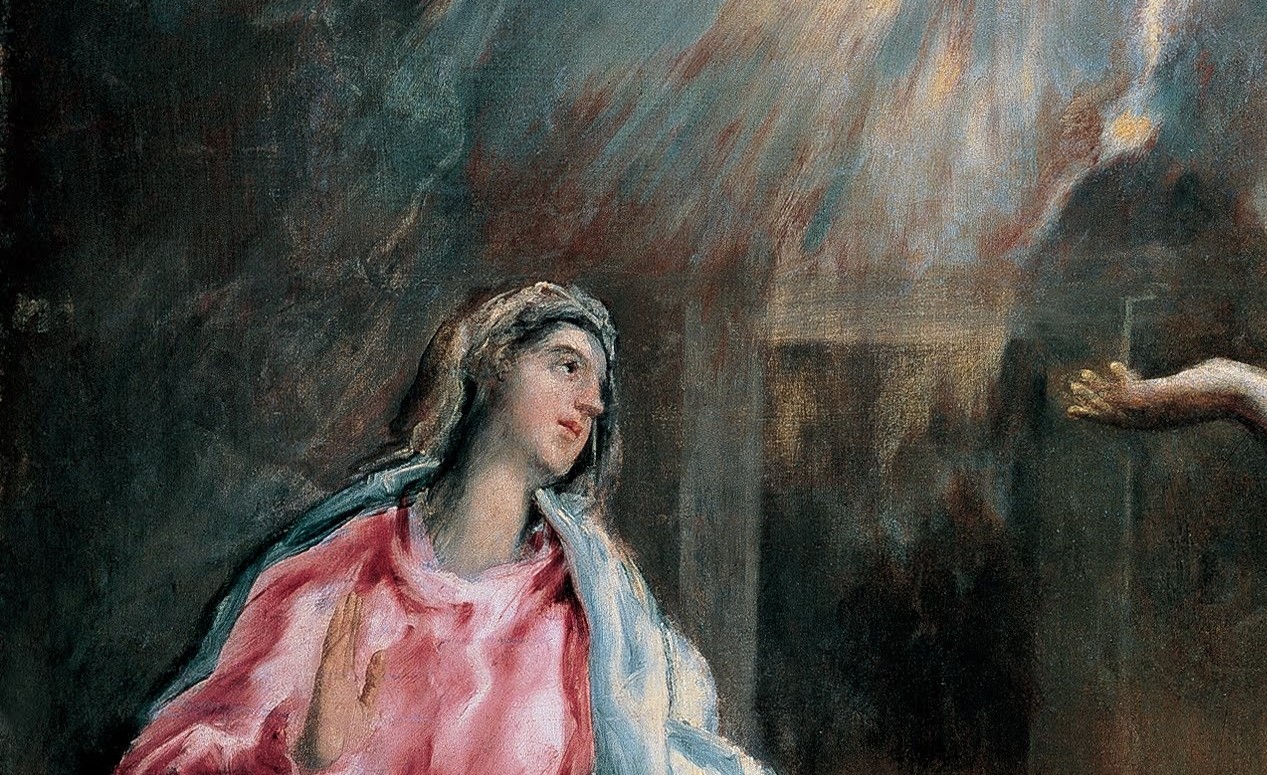
11, 2 And behold, an angel of the Lord stood before her, saying: “Do not be afraid, Mary, for you have found grace before the Lord of all things, and you shall conceive by his word.” But she, on hearing this, was perplexed, thinking: “Shall I conceive by the living Lord God and then give birth as every woman gives birth? ”
11, 3 The angel of the Lord said: “Not so, Mary. The power of the Lord will overshadow you. Therefore the holy one who will be born of you shall be called the Son of the Most High. You shall give him the name Jesus, for he will save his people from their sins.” Mary answered: “Behold the handmaid of the Lord before him. Let it be done to me according to your word.”
12, 1 She worked the purple and the scarlet and brought them to the priest. And the priest blessed her, saying: “The Lord God has magnified your name, Mary, and you shall be blessed in all the generations of the earth.”
12, 2 Mary rejoiced and went to Elizabeth, her kinswoman. She knocked at the door. On hearing her, Elizabeth put down the scarlet, ran to the door, and opened it. Seeing Mary, she blessed her, saying: “Whence comes this gift to me, that the mother of my Lord should come to me? For behold, he who is within me leaped for joy and blessed you.” Mary had forgotten the mysteries of which the archangel Gabriel had spoken to her, and she gazed up to heaven, exclaiming: “Who am I, Lord, that all the generations of the earth should bless me?”
12, 3 She remained three months with Elizabeth, and her womb grew day by day. Then Mary, seized with fear, returned to her house and hid herself from the children of Israel. When these mysteries took place, she was sixteen years old.
13, 1 When her sixth month came, behold, Joseph returned from his building work and, on entering the house, found her with child. Then he struck his face, threw himself down on sackcloth on the ground, and wept bitterly, saying: “With what face shall I look upon the Lord my God? What prayer shall I raise for this young girl? I received her a virgin from the temple of the Lord and I did not keep her. Who has set this snare for me? Who has committed this dishonor in my house, defiling the virgin? Has the story of Adam been repeated in me? For when Adam was at the hour of the doxology, the serpent came, found Eve alone, and seduced her. So it has happened to me as well.”
13, 2 Joseph rose from the sackcloth, called Mary, and said to her: “Beloved of God, why have you done this and forgotten the Lord your God? Why have you humbled your soul, you who were brought up in the Holy of Holies and received food from the hand of an angel?”
13, 3 She wept bitterly, saying: “I am pure and I have not conceived.” Joseph asked her: “Where, then, does what is in your womb come from?” She answered: “As the Lord my God lives, I do not know where this that is within me comes from.”
14, 1 Joseph was greatly afraid. He withdrew from her, reflecting on what he should do. Joseph thought: “If I hide her fault, I shall be fighting against the law of the Lord. If I denounce her to the children of Israel, I fear that what is in her may come from an angel, and in that case I shall have handed innocent blood over to the judgment of death. What shall I do, then? I will send her away secretly.” And so night overtook him.
14, 2 And behold, an angel of the Lord appeared to him in a dream, saying: “Do not be afraid for this young girl. What is in her comes from the Holy Spirit. She will give birth to a son, and you shall give him the name Jesus, for he will save his people from their sins.” Joseph awoke from sleep, glorified the God of Israel, who had granted him this privilege, and kept her.
15, 1 Annas the scribe came to him and said: “Why did you not appear at our council?” Joseph answered: “Because I was weary from the journey, and on the first day I rested.” As he turned, the man saw that Mary was with child.
15, 2 Then he ran to the priest and said to him: “Joseph, for whom you stand surety, has gravely violated the law.” The priest answered: “How so?” “The virgin he received from the temple,” the other answered, “he has defiled. He took her in marriage by fraud and did not make it known to the children of Israel.” The priest said: “Has Joseph done this?” Annas the scribe said: “Send officers and you will find the virgin with child.” The officers went, found it as he had said, and brought her with Joseph to the court.
15, 3 The priest said: “Why have you done this, Mary? Why have you humbled your soul and forgotten the Lord your God, you who were brought up in the Holy of Holies and received food from the hand of an angel, who heard the sacred hymns and danced before him? Why have you done this?” But she wept bitterly, saying: “As the Lord my God lives, I am pure before him and I have not known a man.”
15, 4 To the priest Joseph said: “As the Lord my God lives, I am pure concerning her.” The priest said: “Do not speak falsehoods, speak the truth. You took her in marriage by fraud and did not make it known to the children of Israel. You did not bow your head beneath the mighty hand, that your offspring might be blessed.”
16, 1 The priest said: “Give back the virgin you received from the temple of Jerusalem.” Joseph then shed burning tears. The priest went on: “I will give you to drink the water of the ordeal of Jerusalem, which will make your sins manifest before your eyes.”
16, 2 And taking it, the priest made Joseph drink and sent him into the hill country. He came back safe and sound. He also made Mary drink and sent her into the hill country. She came back safe and sound. And all the people marveled that no sin appeared in them.
16, 3 Then the priest said: “God has not made your sins manifest. Neither do I judge you.” And he dismissed them. Joseph took Mary and returned full of joy to his house, glorifying the God of Israel.
17, 1 An order came from the emperor Augustus that a census be taken of all the inhabitants of Bethlehem of Judea. Joseph thought: “I will have all my sons enrolled. But what shall I do with this young girl? How shall I enroll her? As my wife? I am ashamed. As my daughter? But all in Israel know that she is not my daughter. This is the day of God, and God will do according to his good pleasure.”
17, 2 He saddled the donkey and had Mary sit upon it. His son led the animal and Joseph accompanied them. When they had gone three miles, Joseph turned and saw her sad, and said to himself: “Probably what is in her is making her suffer.” Turning again, he saw that she was smiling. Then he asked her: “What is the matter with you, Mary, that I see your face now smiling, now grieved?” Mary answered Joseph: “It is because I see with my own eyes two peoples: one is blind and in mourning, the other is full of joy and rejoices.”
17, 3 When they had come halfway, Mary said to him: “Take me down from the donkey, because what is within me is in haste to come forth.” He took her down and said to her: “Where can I take you to protect your modesty? The place is deserted.”
18, 1 There he found a cave, led her inside, and left his sons with her. Then he went out to look for a Hebrew midwife in the region of Bethlehem.
18, 2 I, Joseph, was walking and not walking. I looked at the air and saw the air seized with amazement. I looked at the vault of heaven and saw the sky standing still and the birds of heaven motionless. I looked at the earth and saw a vessel set there and workmen reclining with their hands in the vessel. But those who were chewing were not chewing, those who were taking food were not lifting it from the vessel, those who were carrying it to their mouths were not carrying it. The faces of them all were turned upward.
18, 3 Behold, sheep were being driven forward and yet they stood still. The shepherd raised his hand to strike them, but his hand remained suspended in the air. I looked at the stream of the river and saw the mouths of the kids resting on the water, but they were not drinking. Then, in an instant, all things resumed their course.
19, 1 I saw a woman coming down from the hill country, and she said to me: “Where are you going, O man?” I answered: “I am looking for a Hebrew midwife.” And she: “Are you from Israel?” “I am,” I answered. And she went on: “And who is it that is giving birth in the cave?” “Mary, my betrothed,” I answered. She asked me: “Is she not your wife?” I answered: “She is Mary, brought up in the temple of the Lord. I received her by lot as my wife, and she is not my wife, but she has conceived by the Holy Spirit.” The midwife asked him: “Is this true?” Joseph answered: “Come and see.” And the midwife went with him.
19, 2 They stopped at the place of the cave, and behold, a shining cloud covered the cave. The midwife said: “Today the soul of Mary has been magnified, because my eyes have seen wonders and because salvation has been born for Israel.” Immediately afterward the cloud withdrew from the cave, and a great light appeared in the cave which the eyes could not bear. A little later that light gradually diminished until the child appeared. He came and took the breast of Mary, his mother. The midwife exclaimed: “Today is a great day for me, because I have seen this new miracle.”
19, 3 Coming out of the cave, the midwife met Salome and said to her: “Salome, Salome, I have witnessed an unheard-of miracle to tell you about: a virgin has given birth, something her nature is not capable of.” Salome answered: “As the Lord lives, unless I put in my finger and examine her nature, I will never believe that a virgin has given birth.”
20, 1 The midwife went in and said to Mary: “Prepare yourself, for there is no small contention concerning you.” Salome put her finger into her nature and let out a cry, saying: “Woe to my iniquity and to my unbelief, for I have tempted the living God, and behold, now my hand is falling away from me, burned.”
20, 2 And she bent her knees before the Lord, saying: “God of my fathers, remember me, for I am of the stock of Abraham, of Isaac, and of Jacob. Do not make me an example to the children of Israel, but give me back to the poor. You, Lord, know that in your name I practiced my healings and from you I received my reward.”
20, 3 And behold, an angel of the Lord appeared to her, saying: “Salome, Salome, the Lord has heard you. Bring your hand near to the child and take him up, and health and joy will come to you.”
20, 4 Salome drew near and took him up, saying: “I will worship him, because a great king has been born for Israel.” And immediately Salome was healed and went out of the cave justified. And behold, a voice said: “Salome, Salome, do not make known the wonderful things you have seen until the child has entered Jerusalem.”
21, 1 Afterward Joseph prepared to set out for Judea. In Bethlehem of Judea there was a great tumult, because magi came, saying: “Where is the king of the Jews who has been born? We saw his star in the East and have come to worship him.”
21, 2 On hearing this, Herod was troubled and sent officers to the magi. He also summoned the chief priests and questioned them, saying: “How is it written concerning the Christ, where is he to be born?” They answered: “In Bethlehem of Judea, for so it is written.” And then he dismissed them.
21, 3 He also questioned the magi, saying: “What sign have you seen concerning the king who has been born?” The magi answered: “We saw a very great star shining among the stars and outshining them, so that the stars no longer appeared. Thus we knew that a king had been born for Israel, and we have come to worship him.” “Go and search,” said Herod, “and if you find him, let me know, so that I too may go and worship him.” And the magi departed.
21, 4 And behold, the star they had seen in the East went before them until they came to the cave, and it stopped over it. The magi, seeing the child with Mary, his mother, took gifts out of their bags: gold, frankincense, and myrrh.
21, 5 Having been warned by an angel not to enter Judea, they returned to their own country by another way.
22, 1 Realizing that he had been deceived by the magi, Herod flew into a rage and sent murderers, saying: “Kill the children two years old and under.”
22, 2 Mary, hearing that the children were being slaughtered, took the child, wrapped him in swaddling clothes, and laid him in an ox manger.
22, 3 Elizabeth too, hearing that they were looking for John, took him and went up into the hill country, looking around for a place to hide. But there was no place to serve as a hiding place. Then Elizabeth, groaning, cried out with a loud voice: “Mountain of God, receive a mother with her child.” And immediately the mountain opened and received her. And a light appeared to them, because an angel of the Lord was with them to guard them.
23, 1 Herod, meanwhile, was searching for John and sent officers to Zechariah, saying: “Where are you hiding your son?” He answered: “I am a public minister of God and I remain constantly in the temple of the Lord. I do not know where my son is.”
23, 2 The officers went back to report all this to Herod. Enraged, Herod said to them: “It is his son who will reign over Israel.” Therefore he sent again to say to him: “Tell the truth: where is your son? You know well that your blood is under the hand of the Lord.”
23, 3 Zechariah answered: “If you shed my blood, I shall be a witness of God. My spirit will be received by the Lord, because you will be shedding innocent blood in the vestibule of the temple of the Lord.” At daybreak Zechariah was killed. The children of Israel did not know that he had been killed.
24, 1 At the hour of the greeting, the priests came out, but Zechariah did not come to meet them, as was his custom, with the blessing. The priests stood waiting for Zechariah, to greet him in prayer and to glorify the Most High.
24, 2 But since he delayed, they all became afraid. One of them took courage, went in, and saw congealed blood beside the altar and heard a voice saying: “Zechariah has been killed. His blood will not be wiped away until his avenger comes.” On hearing these words, he was afraid and went out to inform the priests.
24, 3 They took courage, went in, and saw what had happened. The beams of the temple groaned, and they tore their garments from top to bottom. They did not find his body, but they found his blood turned to stone. Filled with fear, they went out and announced to all the people that Zechariah had been killed. All the tribes of the people learned of it, wept, and mourned for three days and three nights.
24, 4 After three days, the priests decided whom they would put in his place, and the lot fell upon Simeon. He was the one to whom the Holy Spirit had made known that he would not see death before he had seen the Christ in the flesh.
25, 1 After the death of Herod, when a tumult had arisen in Jerusalem, I, James, who wrote this history, withdrew into the wilderness until the tumult in Jerusalem ceased, glorifying the Lord God, who granted me the gift and the wisdom to write this history.
25, 2 Grace will be with those who fear our Lord Jesus Christ, to whom be glory forever and ever. Amen.
Conclusion
The Protoevangelium of James, although it is an apocryphal writing and therefore does not belong to the canon of Scripture, holds a decisive place for understanding how the early Christian tradition elaborated, transmitted, and imagined the origin of Mary and the first steps of the mystery of the Incarnation. In narrative and symbolic language, the text presents a theology of God’s action in history, insisting on the divine initiative that visits the timid, reverses barrenness, fulfills promises, and leads events toward the manifestation of the Savior.
In recounting the conception and birth of Mary, her dedication to the temple, and the announcement of the birth of Jesus, the work reinforces themes that would later become central to Marian piety and reflection, such as the singular holiness of the Mother of the Lord, her total belonging to God, and the understanding of her mission in the light of the economy of salvation. At the same time, it shows how early Christianity sought to express, with its own literary resources, the integrity of the virginal motherhood and the divine origin of the Son, articulating elements of biblical tradition with theological and catechetical motifs.
Read with discernment, the Protoevangelium of James does not serve as a normative source of faith, but as a historical witness to an ancient reception of the Christian mystery and to a nascent Mariology, strongly marked by the dimension of the sacred, by the symbolism of the temple, and by the conviction that the history of Mary is intrinsically oriented toward Christ. In this sense, its relevance remains current for anyone who wishes to study the formation of the Marian tradition, the dynamics of apocryphal literature, and the development of the representations of Mary in the imagination and the spirituality of the Church.
For the magisterial framework on Mary in the Christian sources, see Lumen Gentium ch. VIII of the Second Vatican Council: Mary biblical and patristic sources of the Marian faith. Read also: The sorrow of Mary and The presence of Mary in the life of the Church.
Deepen your studies: explore Mariology, Marian Theology, Marian apparitions, and the Postgraduate Program in Mariology.
To deepen the biblical and patristic study of Mary and her roots in the early Christian tradition, see the Encyclical Redemptoris Mater of Pope John Paul II.
Postgraduate Program in Mariology
Would you like to deepen your formation in Mariology? Discover the Postgraduate Program in Mariology of Locus Mariologicus, an academic formation that unites theological rigor, spiritual life, and the living tradition of the Church.
See our complete guide to Catholic Angelology.
Would you like to study angelology and demonology in depth?
This article comes from the Locus Mariologicus library. The postgraduate specialisation in Angelology and Demonology (360 hours, fully online) studies angels and demons in Scripture, the Fathers and the Magisterium, with a whole area on practical demonology, exorcism and deliverance prayer. The new class begins on 18 January 2027. Classes are taught in Portuguese.



Responses