Mary in Christ Reconciles Us with Ourselves and with Others
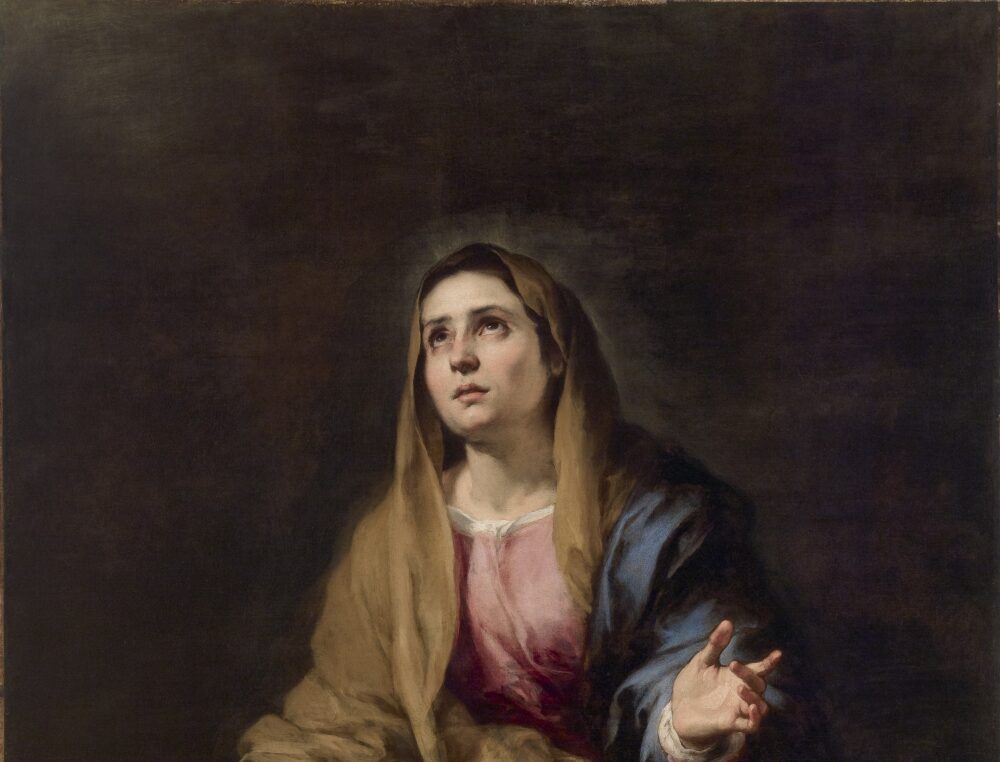
Mary in Christ is reconciled by God with herself by way of pre-redemption, which is why she is immaculate. But she is so in Christ not only by privilege, but also, and even more, as minister of our reconciliation with God: a unique, irreplaceable ministry, always in act. She is immaculate for us. She is a woman of courageous faith for us. She is sorrowful, almost to the point of dying with the Son on Calvary, for us. She is assumed for us. Mother of the Church, by the strength of charity in the Holy Spirit of Christ. She who was faithful stands at the summit of the “remnant” of the people of Israel.
But, by reconciling us in Christ with God, Mary also reconciles each of us with himself. She reconciles us with one another, so as to make of humanity a family of brothers.
Mary in Christ reconciles us with ourselves
Extroversion and the cultural division of the person
What is the condition of individual man today? He has lost the fundamental certainties that expressed the meaning of life and gave serenity to conscience, in every dimension. They gave the will the energy to decide. They gave creativity and joy to our acting. We were in the world as a person in the image of God, a person not in an individualistic sense, but as an I that opens to the other as a thou, in order to form a we: community, city.
Today, every man who thinks feels inwardly insecure, because he is divided within himself between aspiration and reality. In truth, this has always happened: think, for example, of Saint Augustine before he came to Christ. Yet around us there emerged and took hold a world of values that had the strength to orient us, and in the end the interior division between aspiration and reality found its solution. The interior reconciliation of ourselves with ourselves came about.
Today this is not entirely impossible, but it has become much more difficult. The world as “natural environment” has been replaced by a world as “cultural environment”, which is often such that man is alienated, torn away and distracted from himself, and manipulated: he does not live, but is lived by the surrounding world.
We have lost our autonomy as persons: person, I repeat, as an “I” that opens to the other as a “thou” in order to form community, a city of values. And it is painful to think that we have lost that autonomy and have let ourselves be manipulated and inwardly split, rejecting the One who was the founding reason of that autonomy: God.
“God is dead”, it was said in the fifties, because He would not have saved us from the horrors of the war, which, however, man himself had willed. God is no longer of any use, it was said in the sixties, because technology had brought about such rapid economic progress that we deluded ourselves that from then on man could build his own earthly paradise by himself, individual and social well-being without limits, for all.
And so suspicion and rejection, beginning with God, extended to the whole past: it smelled too much of an order dominated by God. From a legitimate “secularization” we passed to “secularism” or “laicism”.
What is the result of this race toward a new promised land? It finds itself between two voids: that of the rejected past. That of the future, which reduces man to a mere servant of the computer that produces only matter to be consumed and therefore reduces man to a mere consumer. And so that he may consume, false needs are created within man by the mass media, and he is thus transformed into a chain of needs that attribute value to things that have none. Hence the interior split between the deep man of the heart and the extroverted man on the surface, who is manipulated by an environment that is no longer a city on the scale of natural man.
What can Mary say to us and give us?
What is to be done? Reject or modify this city? Modify it. But in order to modify it without renouncing the new values, and thus reconcile the man of today with himself while he remains a man of today, what can Mary say to us, what can Mary give us? The question arises in a special way for women.
Paul VI, in the apostolic exhortation “Marialis Cultus”, observes:
“In devotion to the Virgin… an uneasiness is perceived: the distance, that is, between certain contents of that devotion and the anthropological conceptions of today and the profoundly changed psycho-sociological reality in which the men of our time live and work…
From this there results, in some, a certain disaffection toward devotion to the Virgin and a certain difficulty in taking Mary of Nazareth as a model, because the horizons of her life, it is said, seem narrow in comparison with the vast areas of activity in which contemporary man is called to act” (no. 34).
Certainly, the world in which Mary worked was enclosed within a small village of Galilee, Nazareth, as a simple housewife in a carpenter’s house. And the culture of the region did not go beyond the concerns of the daily life of simple people.
But here a fundamental and decisive question must be raised: is the surrounding world the measure of man’s greatness, so that the smaller that world is, the smaller and more insignificant man is; or is man the measure of the world, wherever he may find himself? And does man’s greatness lie above all in interiority, and is it measured by the greatness of God? And therefore by the greatness of the values that worldly reality takes on when it enters into contact of service with that interiority?
The answer admits of no doubt: it is man, with the values he creates, even if they remain immanent in the person. It is this man who constitutes the true greatness of the world, the great culture of the world.
In the Gospel of Matthew we have a page in which Jesus reveals to us which are the figures of man and which are the works that in fact attain value and therefore the permanence of “history”, in contrast with what makes mere “chronicle” and lasts only an hour.
In chapter 25, He tells us that in the actions of man, beyond the dimension of factuality that for us makes “news”, there exists a dimension of value that already possesses the intensity and the vastness of the eternal life of the Kingdom of God. It is the “meta-history” immanent in “history”: it does not make “news”, it does not make “secularist culture”. Often it passes completely unnoticed by men. But it emerges in the conscience of the one who acts as a person, and it is known and judged by God.
Thus, whoever gives food to the one who is hungry. Whoever gives drink to the one who is thirsty. Whoever clothes the one who is naked. And visits the one who is in prison, and so on, performs acts of the highest value, acts that have the permanence of history and the vastness of the Kingdom of God, even if they are actions of a single instant in a place without splendor. In the same way, whoever does not give food to the one who is hungry, does not give drink to the one who is thirsty, and so on, commits acts of omission that are not even noticed by men, especially today. But they are of a gravity and a permanence that are measured only by exclusion from the Kingdom of God.
When, therefore, we ask ourselves whether Mary has something to say to us and to give us in order to compose, to reconcile interior reality and external worldly reality, we must seek the answer in the dimension of values, of true values, even if they do not make the news. Even if extroverted culture ridicules true interiority and proposes as values those that are not. And exalts them with monuments and weaves praise for them in libraries full of books.
She teaches us to make decisions as a person of true and great history
At bottom, it is a matter of answering truthfully the question: what is man? What are the truly human values? It is, then, a matter of an anthropological discourse. And it is the discourse that Paul VI wants to be made when treating of Mary, and which he, in his apostolic exhortation, begins with a few reflections. I recall one of them here:
“The reading of the divine Scriptures, carried out under the influence of the Holy Spirit and with the achievements of the human sciences and the various situations of the contemporary world in mind, will lead to the discovery of how Mary can be taken as a mirror of the expectations of the men of our time. Thus, to give a few examples, the contemporary woman, desirous of sharing decision-making power in the choices of the community, will contemplate with intimate joy Mary who, admitted to dialogue with God, gives her active and responsible consent, not to the solution of a contingent problem, but to that ‘work of the ages’, as the incarnation of the Word has rightly been called”, (no. 37, Saint Peter Chrysologus, Sermo 143).
This page of Paul VI must be meditated upon, precisely because of our theme: Mary, in Christ, by reconciling us with God, also reconciles each of us with himself.
One must therefore underline in Mary the act of decision, the courage with which she decides, the wise and deliberate manner, even while standing before God, and finally the docility and the totality of that decision, which was a decision of faith.
This was a true fundamental moral option of a mature person: by it she gave a new finalizing meaning to her whole life. And she also accepted an unknown and therefore a risk. But she knew well who God was: the God of Abraham, of Isaac, of Jacob, the God whose promises she believed and to whom she still remained faithful, as that person in whom the “People of God”, the “Remnant of Israel”, had its highest expression.
Certainty of faith and of historical experience, and therefore security. And then firmness in taking, persevering in, and bringing to completion the path marked out by God.
All of this is what is asked today so that modern man may rediscover the meaning of his own life, in whatever environment he may be, in whatever culture he may find himself, whether he carries out a humble work in a little house or pilots a spacecraft toward the moon. The vastness of earthly horizons is always a small thing before the vastness of conversing and then walking with God.
But Mary is not only a model of how we must give meaning to our person as we act in our own time: she is present in the interior principle that forms this person of ours, and therefore she is at the root of our identity and of our continual synthesis between interiority and the reality of the surrounding world, without our being scattered, without our being distracted. To be always ourselves and yet to serve and create values around us. To conciliate or reconcile reality with us and us with reality.
How is Mary the principle of all this in us?
We must reflect on the expression of Saint Peter Chrysologus, cited by Paul VI to designate the incarnation of the Word: “it is the work of all the ages”. The work desired by all the ages, since the creation of the world. The work present and operative in the history of all the ages, in all men, until the ages come to an end and the heaven of the risen Christ is our dwelling, where God will be all in all.
Universal reconciliation at the height of its fulfillment, wrought by God in Christ.
This is not oratorical imagination on the part of Saint Peter Chrysologus. It is revealed doctrine, especially through Saint Paul. In the letter to the Ephesians it is designated as the “economy of the fullness of times”, with an eschatological tension (tòn kairón), which has its summit in the recapitulation of all things in Christ (Eph 1:10. Cf. 1 Cor 15:24-28).
In saying Yes, the “fiat”, to God, God, in Christ, took Mary as His particular minister in this work. This fiat was renewed and in fact took on a salvific dimension and tension, as “socia Christi”, on Calvary, and finally it revealed her publicly in its ecclesial dimension and tension on the day of Pentecost. With the assumption, she was taken up into the heaven of the Risen One, always as minister in act of the Risen One with her motherhood. Now, precisely because of this maternal ministry, she is not only an example so that we too may say Yes to God, but she operates within the action of Christ with the energy of the Holy Spirit. All of this should cause no surprise, if one understands that it takes place in a proper space, which is the space of the Church, the Church as mystery.
She teaches us to act in harmony with the merciful charity of the Holy Spirit of God in Christ
As a unique member in her ministeriality to Christ in the Church, Mary does not act only as a principle, on God’s part, with her “fiat”, but she also acts with her ecclesial charity, moving us to say, as she said it and together with her who always repeats it, our own Yes to God. It is a communion of charity and of prayer that forms communion, which is expressed in Marian popular piety, moved and always animated by the Holy Spirit.
Mary’s action within us and the action of the Church here merge into a single action of reconciliation, that is, of the identity of the Christian: an identity that is restored if one is outside charity through sin, and that is intensified if one is already in charity, until we become, with Mary, saints with the holiness of Christ, of the Christ who expresses Himself in the Church for the world.
And here one can also understand another great truth and practice that animates authentic Marian piety: Mary’s solicitude for sinners and the confidence of sinners in Mary. It is always the same charity of Mary that circulates in the Church, together with the charity of all the saints. Sinners are reached by her, because it is a dogmatic truth that sinners, by virtue of the indelible baptism and, let us also say, of confirmation, although they have lost sanctifying grace and charity, are nevertheless members of the Church and are under the action, I would even say the pressure, of ecclesial and Marian charity, so that they may be converted.
The Second Vatican Council says this explicitly:
“Those who approach the sacrament of penance obtain from the mercy of God the pardon of the offenses committed against Him and, at the same time, are reconciled with the Church, which they wounded by their sin, and which cooperates in their conversion by charity, example, and prayer”, (Lumen gentium 11).
Only the one who denies the Church by an act of apostasy and positively sets himself against the action of the Holy Spirit is as though separated from the Church and deprived of the goods that come from the influx of ecclesial and Marian charity. And yet God’s tenderness does not lose sight of these unhappy souls.
In the first centuries of the Church, much attention was given to those who, although they were not in full communion with the Church, were bound to her, whether by the catechumenate, in the case of those preparing for baptism, or in the case of sinners who, although they did not receive or could not receive penance, suffered, wept over their sin, and gave alms. They were thus disposed for final penance before dying, with the penitential imposition of hands, if they had not yet received penance, or at least with viaticum.
And if some died without this last action of the Church, but had desired it, the Church prayed for them also after death, imploring of the most merciful God that there be no eternal condemnation for those who had passed away in this way.
All this richness of the charity of the Church, with its original pastoral practices, was modified over time. It would be necessary to take up that charity again and adapt it to the pastoral demands of our time, for the reconciliation, at least gradual, of Christians who feel themselves in difficulty and have great need to find themselves again and to place themselves in trusting prayer to God.
The economy of the Church, that is, of Christ who makes Himself Church, is an economy of reconciliation. It is an economy of “mercy”, that is, according to biblical terminology, of the love of the paternal and maternal tenderness of God, in Christ, toward the world. In this economy, God the Father, in Christ and in the Holy Spirit, willed that Mary be a minister of motherhood, especially toward sinners. Thus, to enter into the circuit of Mary’s love is to enter into a circuit of sure salvation. Saint Alphonsus writes:
“This is the principal office that was given to Mary when she was placed on earth: to raise up the souls fallen from divine grace and to reconcile them with God”, (Saint Alphonsus, Le glorie di Maria chap. 6, § 3).
And he adds that: “devotion to Mary is a grace that God grants to those whom He wills to save”, (op. cit., chap., § 1).
Conclusion
Throughout these reflections the guiding thread has remained the same: Mary, inseparable from Christ and wholly relative to Him, is the singular minister of the reconciliation that God accomplishes in Christ, and for this reason she reconciles us with God, with ourselves, and with one another, so that humanity may become a true family of brothers. This maternal mediation does not diminish the uniqueness of Christ; rather, it manifests it in its historical and ecclesial fruitfulness, because it is exercised in the proper space in which Christ acts and communicates His life, the Church as mystery.
On the anthropological level, contemporary man frequently experiences the interior fracture between aspiration and reality, aggravated by a cultural environment that scatters, alienates, and fragments the person. The Christian answer to this crisis is not flight from the world, but the recovery of interiority as the place of the truth of man before God. Here Mary appears as a mirror of the legitimate expectations of our time: woman, and with her every human being, recognizes in her the greatness of a fully personal, conscious, and responsible decision, her Yes of faith, not in order to resolve a contingent problem, but in order to welcome the “work of the ages”, the incarnation of the Word (Paul VI, Marialis Cultus 37. Saint Peter Chrysologus, Sermo 143, Patrologia Latina 52, 583). It is precisely this spiritual maturity, lucidity, courage, and total docility that restores interior unity and gives meaning back to our acting, whether in daily humility or in the broader tasks of culture and technology.
This decision of Mary, her fiat, does not remain a merely exemplary memory, but by divine disposition it places her at the heart of the economy of salvation, that “economy of the fullness of times” in which all things are recapitulated in Christ (Eph 1:10. Cf. 1 Cor 15:24-28). For this reason Mary is not merely an external model: she is present, as mother, in the interior principle that sustains our Christian identity, helping us to maintain the synthesis between interiority and the surrounding world, without dispersion and without loss of ourselves. To say Yes to God, with Mary and like Mary, becomes a path of integration: to remain a person, to serve, to create true values, to reconcile reality with us and us with reality, within the horizon of the Kingdom.
Reconciliation, however, also has a pastoral and merciful face. The Church, the body of Christ, lives an economy of reconciliation that is an economy of mercy, that is, of the tender love of God in Christ. Within her, Mary exercises a motherhood particularly directed toward sinners, not as an alternative to grace, but as the maternal expression of the very charity of Christ communicated by the Holy Spirit. For this reason authentic Marian piety, when it is truly ecclesial, does not close in upon feelings, but becomes energy of conversion, prayer, example, and charity. Whoever approaches the sacrament of penance receives the pardon of God and, at the same time, is reconciled with the Church wounded by sin, which cooperates in that conversion “by charity, example, and prayer” (Second Vatican Council, Lumen gentium 11). To take up again, with creativity and prudence, the pastoral richness of the ancient ecclesial solicitude for those who are in difficulty may be a providential path toward the gradual reconciliation of many faithful who are wounded, weary, or distant.
In sum, the proposal is clear and demanding: to rediscover the truth of man in the light of God, and to learn, with Mary, the art of great decisions, which restore unity to the person and open the heart to communion. To enter into the circuit of Mary’s love is to enter into the circuit of the ecclesial charity that the Holy Spirit arouses and sustains, and therefore into a sure path of salvation and of interior reconstruction (Saint Alphonsus, Le glorie di Maria chap. 6, § 3. Chap., § 1). Thus, reconciled in Christ, we become capable of reconciling concrete life as well: relationships, choices, work, culture, history. And, like Mary, we remain faithful in what is essential: to walk with God, so that in our life and in our time the true great history may be manifested, the history that God recognizes and causes to endure.
Deepen this meditation on reconciliation with Mary: Mary in Christ reconciles us with one another and With Mary toward a reconciled Christian community. For the magisterial teaching on reconciliation, see the apostolic exhortation Reconciliatio et Paenitentia: Mary and integral reconciliation.
Deepen your knowledge of Mariology: This article is part of our vast collection of Marian reflection. If you wish to study Mariology with academic rigor, discover our Postgraduate Program in Mariology. To learn more about Marian apparitions and Marian Theology, explore the resources of the Locus Mariologicus Institute.
To deepen the Marian theology of reconciliation and the role of Mary in the redemptive work of Christ, see the Encyclical Redemptoris Mater of Pope John Paul II.
Postgraduate Program in Mariology
Would you like to deepen your formation in Mariology? Discover the Postgraduate Program in Mariology of Locus Mariologicus, an academic formation that unites theological rigor, spiritual life, and the living tradition of the Church.
Would you like to study Mariology seriously?
This article is born of the works in the library of Locus Mariologicus. The Postgraduate Program in Mariology takes you to the same source, with academic guidance: Scripture, the Fathers of the Church, and the Magisterium, from the first dogma to contemporary questions.



Responses