Food that does not perish: Mary and the work for the eternal
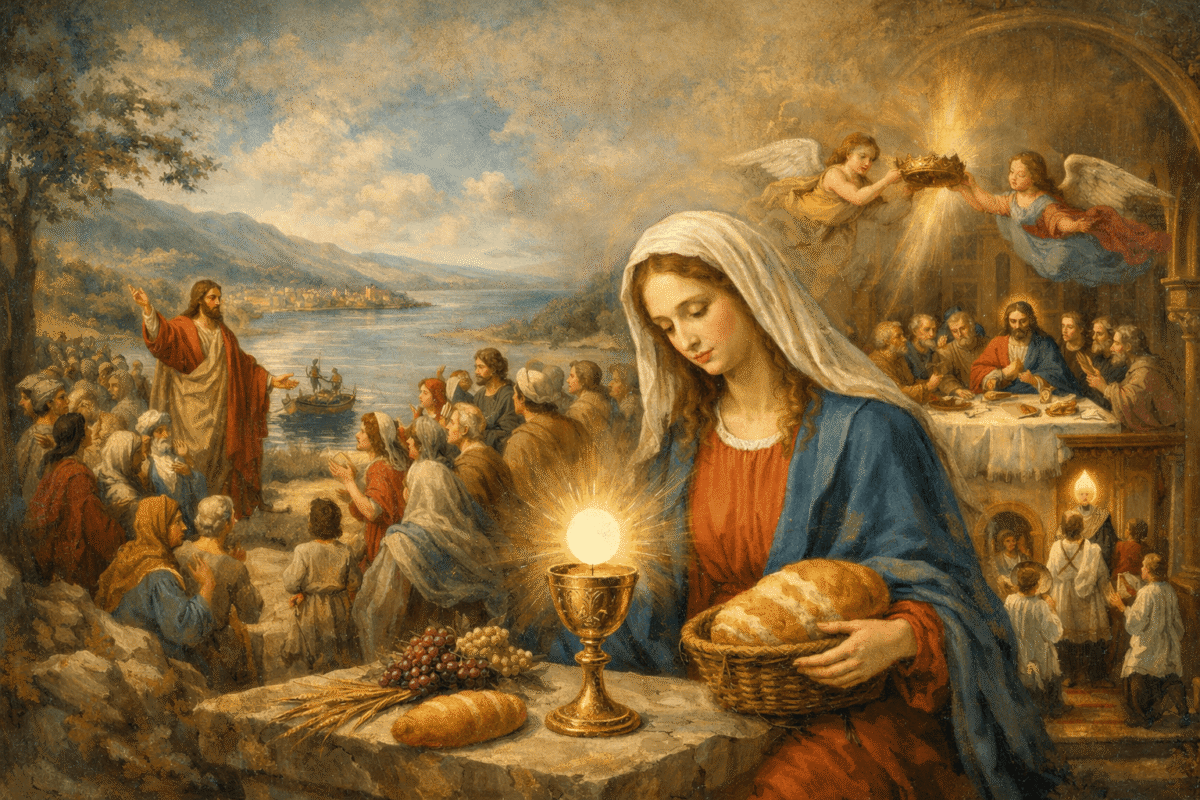
Operamini non cibum qui perit, sed qui permanet in vitam aeternam.
Jn 6:27
After the multiplication of the loaves, the crowds crossed the lake in search of Jesus. “When you sought me it was not because of the signs you saw, but because you ate the loaves and were filled” (Jn 6:26). Jesus reverses the horizon: do not work for the bread that perishes, but for that which endures unto eternal life. This call to the conversion of desire, from the immediate to the eternal, from the perishable to the permanent, finds in Mary its most perfect figure: she who was never satisfied with less than God, who never traded the eternal for the temporal, is the model of an existence oriented toward the food that does not perish.
I. The Distinction of Desires: From the Bread That Perishes to the Bread That Lasts
The spiritual psychology underlying Jn 6:26-27 is subtle and demanding: Jesus does not condemn the desire for bread. The desire for survival and for physical well-being is legitimate and was created by God. What Jesus condemns is the fixation on bread as an end in itself, the idolatry of immediate satiety that forgets the eternal horizon. The desire for full life, for eternal life, must orient and subordinate all other desires, without annulling them, but placing them in their correct place in the hierarchy of ends.
Ignatius of Loyola, in the Spiritual Exercises, called this ordering of desires the fundamental principle of Christian life: “Man is created to praise, reverence, and serve God our Lord and, by this means, to save his soul. And the other things on the face of the earth are created for man and that they may help him in the end for which he is created” (§23). This Ignatian “principle and foundation” is precisely the logic of Jn 6:27: everything has its value, but not everything has the same value, and Christian life is the art of ordering desires according to the eternal. Mary, in whom the “desire for God” was absolute and without rival, is the living model of this ordering that Ignatius systematized theologically.
The distinction between the bread that perishes and the bread that lasts also has a cultural and social dimension. Jesus speaks to a crowd that is seeking material food, a legitimate and urgent need. But in pointing to the “bread that lasts”, He does not deny material need: He integrates it into a broader horizon. Catholic social theology, from Leo XIII to Francis, has learned from this dialectic: the Church that is concerned only with the bread of the body forgets the deepest dimension of the human being. The Church that is concerned only with spiritual bread ignores the concrete need of those in need. Mary, who fed the Son with her milk and who accompanied Him to Calvary, is the model of a motherhood that cares simultaneously for the body and for the soul.
The narrative sequence is important: the crowds that crossed the lake “because they ate the loaves” (Jn 6:26) are exactly the crowds that had just been filled by the sign of the five loaves. Their search for Jesus is not ill will: it is a natural human logic. The problem does not lie in the desire to be filled. It lies in the inability to pass from the sign to the reality, from the eucharistic miracle to the Bread that the miracle anticipated. Jesus does not reject them for seeking bread: He invites them to seek more, not to content themselves with less than God can give.
II. Mary’s “Work”: The fiat as Permanent ‘Praxis’
The Greek verb ergazesthe, “work”, implies a continuous praxis, not an isolated gesture. Jesus’ exhortation is not for a sporadic act of devotion or of temporary conversion. It is for a constant and persistent orientation of human activity toward the eternal. The “work” for the eternal bread is not something done in moments of prayer and then forgotten: it is the texture of an entire life oriented by the horizon of eternal life. It is a quality of intention that transforms every ordinary action into action oriented toward God.
Mary’s vita activa, as tradition describes it, was lived entirely in this orientation. From the fiat of the Annunciation to the visit to the pregnant Elizabeth, from the journey to Bethlehem to the flight into Egypt, from the thirty years of common life in Nazareth to her presence at the decisive moments of the public ministry, from Calvary to the Upper Room, each of these gestures is “work for the eternal”. Every action of Mary, however daily and prosaic it may appear, was oriented by the “bread that does not perish”: she cared for the Son, she fed the family, she took part in the life of the Jewish community of Nazareth, and all of this as a concrete expression of her permanent fiat to the will of God.
The spirituality of ordinary life, developed by Charles de Foucauld and by authors such as Jean-Pierre de Caussade, found in Mary its most natural biblical model. The “thirty years of Nazareth”, the long hidden life of Jesus with Mary before the public ministry, are the paradigm of holiness in daily life: they are not years of preparation for “real life”, but are themselves real life, the “work for the eternal” that is accomplished in the humility of the everyday. Mary, who lived these thirty years beside the Son, in the simplest and most repeated gestures, definitively sanctified ordinary work as a path of holiness.
The Second Vatican Council, in Lumen Gentium (n. 41), affirms that “all the faithful, whatever their condition of life, are called to the fullness of the Christian life and to the perfection of charity”. This universal call to holiness, one of the most important legacies of the Council, has in Mary its foundation and its model: she who found holiness not in extraordinary gestures or in mystical visions, but in fidelity to the “work for the eternal” in the most ordinary life possible, is the most convincing testimony that holiness is within everyone’s reach.
III. The Seal of God and the Authenticity of the Mission
Jn 6:27 concludes with a fundamental christological affirmation: “for it is on Him that God the Father has set His seal”. The Son is the bearer of the Father’s “seal”, the mark of divine authenticity, the sign that certifies that His mission has its origin in God and is not a human initiative. God’s “seal” is the guarantee that the One sent speaks with divine authority and that the bread He offers is truly the eternal food it promises to be.
The Marian theology of Francis de Sales and of John Eudes saw in Mary the creature most “marked” with the seal of God among all human beings. Her Immaculate Conception, her Divine Motherhood, her Assumption, these privileges are not arbitrary ornaments of popular piety, but expressions of the “seal” that the Father set upon Mary in view of her unique mission. The Kecharitōménē of Lk 1:28, “she who has been filled with grace”, is the Marian equivalent of the “marked with His seal” of Jn 6:27: Mary received the divine seal of the fullness of grace because she was chosen for the highest mission a creature can have.
The authenticity of Mary’s mission, like that of the Son, is not based on natural qualities of her own, but on what she received from the Father. Here lies one of the most important lessons of Mariology for spirituality: the efficacy of Christian witness does not come from our natural capacities, but from fidelity to the “seal” of grace that we receive in Baptism. Like Mary, every Christian is called to work “for the bread that does not perish” not because he is naturally capable of it, but because he has been “marked with the seal” of the Spirit (cf. Eph 1:13) that makes possible what would naturally be impossible.
Mary’s cooperation in the Redemption, a theme treated extensively by Scheeben, De la Taille, and Galot, does not replace the unique and unrepeatable work of Christ, but derives from it and converges upon it. Mary works “for the eternal bread” precisely because she was “marked” with the seal of the Father for this mission. Her “work” is always work with and in Christ, who is the only bearer of the Father’s seal in the full sense. This subordination does not diminish Mary. It raises her to the most intimate participation possible in the work of the Son, from within the condition of a creature.
IV. The Eucharist as “Bread That Does Not Perish”
In the eucharistic context in which the whole pericope is set — Jn 6 is the great eucharistic discourse of the fourth Gospel — the “bread that endures for eternal life” is, in the first place, Christ in the Eucharist. The Eucharist is the food that transforms time into eternity, that introduces the “already” of eternal life into the “not yet” of historical existence. Whoever eats the eucharistic Bread participates, in a real and not merely symbolic manner, in the eternal life of the risen Son. The eschatological dimension of the Eucharist, underscored by Henri de Lubac in Corpus Mysticum, is inseparable from its sacramental dimension.
Mary, “woman of the Eucharist” (John Paul II, Ecclesia de Eucharistia), is the figure of that mode of existence which makes the reception of the Eternal the center of all activity. Her life in Nazareth, apparently the most ordinary of lives, was a eucharistically oriented life: the “bread” that she prepared for the Son was the same body that one day would become the Bread of the Eucharist. This continuity between the homemade bread of Nazareth and the eucharistic Bread of the Last Supper, a continuity that passes through the same body of Jesus, is one of the most tenderly human mysteries of the Christian faith, and Mary is its living point of articulation.
The intercession of Mary in the Eucharist, expressed liturgically in the Communicantes of the Roman Canon, is the extension of her motherhood to the sphere of the “eternal bread”. In every Eucharist, Mary intercedes so that her children may not content themselves with the bread that perishes, with immediate satisfactions, with passing comforts, with worldly successes, but may work for the bread that lasts. This intercession is not passive: it is active and maternal, as it always was at Cana when she said “they have no wine” and as it always is when she presents to the Son the needs of her spiritual children.
The closing of this section of the pericope, “What shall we do to perform the works of God? / This is the work of God: to believe in Him whom He has sent” (Jn 6:28-29), resolves the question of “work” in a surprising direction: the “work” that God asks is not an ascetical or moral performance, but faith in the One sent. Mary, who believed, the Kecharitōménē who said fiat, accomplished the most perfect of the “works of God” precisely because her faith was total. And it is this total faith, this unreserved openness to the One sent by God, that constitutes the highest model of “working for the bread that does not perish”.
May Mary, who consecrated her whole life to the one work that lasts, help us to order our desires and our energies toward the Bread that comes down from Heaven, and may she accompany us in this paschal season.
Postgraduate Program in Mariology
Would you like to deepen your formation in Mariology? Discover the Postgraduate Program in Mariology of Locus Mariologicus – an academic formation that unites theological rigor, spiritual life, and the living tradition of the Church.
Would you like to study Mariology seriously?
This article is born of the works in the library of Locus Mariologicus. The Postgraduate Program in Mariology takes you to the same source, with academic guidance: Scripture, the Fathers of the Church, and the Magisterium, from the first dogma to contemporary questions.




Responses