Reddite deo quae sunt dei: Mary and Total Consecration to God
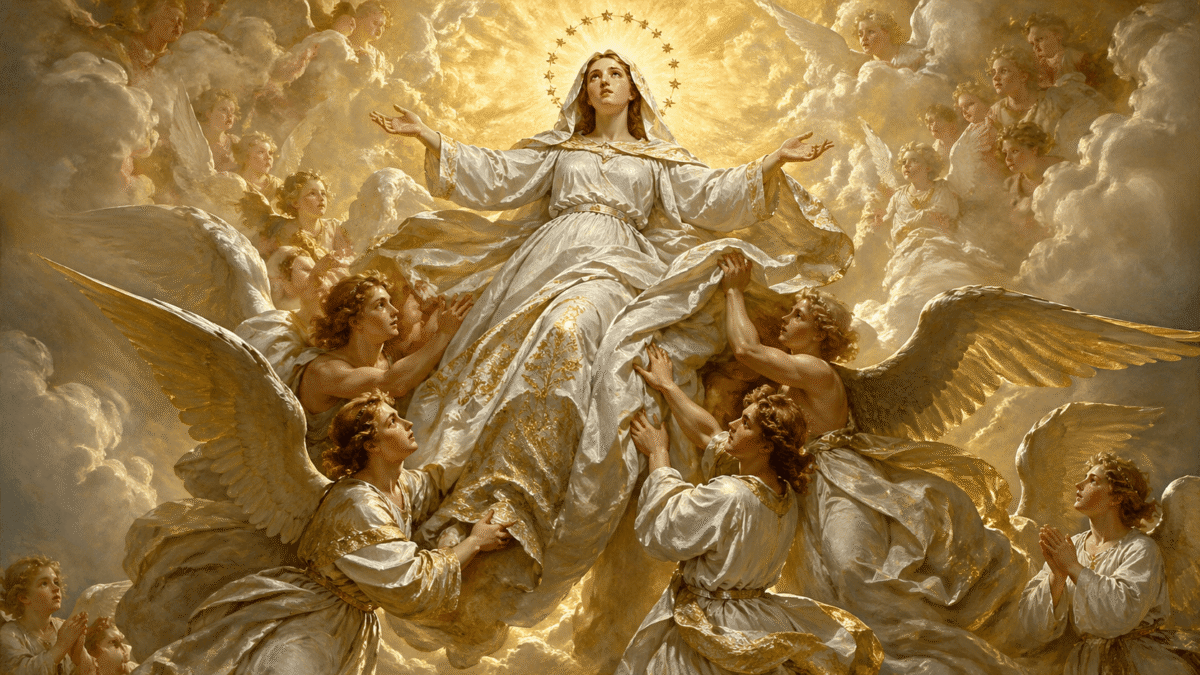
Reddite quae sunt Caesaris Caesari et quae sunt Dei Deo.
Mk 12:17
The question of the tribute to Caesar (Mk 12:13-17) is one of the most famous traps that Jesus’ adversaries tried to set for Him: a political question with religious implications, contrived so that any answer would seem problematic. Jesus escapes with an answer that distinguishes two domains, that of Caesar and that of God, but which, read in depth, places the decisive accent on the second: “give to God what is God’s.” Mariology finds in this mandate the foundation of a spirituality of total consecration: Mary, who in the “fiat” gave back to God everything that belonged to Him, is the model of the creature who understood what it means to “give to God what is God’s.”
I. Reddite deo: The Trap and the Wisdom of Jesus
The question of the Pharisees and Herodians was sophisticated: the tribute to Caesar in Roman coin was a sensitive subject in occupied Palestine. To pay was to collaborate with the occupier. To refuse was political rebellion. Jesus asks them to show Him the coin, observes the image of Caesar, and asks: “Whose image and inscription is this?” The answer, “Caesar’s,” prepares the conclusion: “Give to Caesar what is Caesar’s and to God what is God’s.”
The apparent separation of domains that Jesus proposes is not a secularist doctrine of the separation between religion and State; it is a more radical affirmation: there is a domain of God that cannot be invaded by any Caesar. This domain of God includes, in the final analysis, everything that bears the “image” of God, that is, the human being (Gen 1:26-27). The coin bears the image of Caesar. The human being bears the image of God. “To give to God what is God’s” means, in the final analysis, to give back to God the whole human being.
Jesus’ wisdom in this answer is not merely rhetorical; it is theological: He rejects both the clericalism that wants to fuse the political with the religious and the secularism that wants to exclude God from the public domain. There is a legitimate sphere belonging to Caesar. But this sphere is always subordinate to the more fundamental sphere of God. No Caesar can claim what belongs to God, and what belongs to God is the human being made in His image.
Jesus’ answer provokes “amazement” in His interlocutors (Mk 12:17). This amazement is not merely admiration for rhetorical skill; it is the astonishment before a wisdom that goes to the heart of questions without letting itself be imprisoned by false alternatives. This wisdom has a Marian icon: the “Sedes Sapientiae,” the Throne of Wisdom, who is Mary, who bore Wisdom and who was shaped by Wisdom throughout her life.
II. “Imago dei”: The Human Being Who Belongs to God
Gen 1:26-27: “Let us make man in our image and likeness (…) He created him male and female.” The “image of God” (imago Dei) in the human being is the biblical foundation of human dignity: the human being is not the property of Caesar or of any other human power; he is “God’s,” made in His image. “To give to God what is God’s” means, in the final analysis, to recognize this origin and this destiny: we are from God and for God. Jesus’ “Reddite Deo” interprets the imago Dei as a vocation of total belonging.
The patristic tradition, in particular Augustine in the De Trinitate and Gregory of Nyssa in the De Hominis Opificio, developed the theology of the imago Dei with great depth: the image of God in the human being is not merely an ontological privilege; it is a dynamic vocation. We are the “image” of God not in a static way but in a processual way: grace progressively restores the image disfigured by sin, until the full likeness that the beatific vision will consummate.
Mary is, in the tradition, the creature in whom the imago Dei was most perfectly realized. The Immaculate Conception is not the suppression of Mary’s humanity; it is its fullest realization: Mary without original sin is Mary most fully the “image of God,” without the disfigurement that sin introduces. She who was preserved from this disfigurement is the one who most completely “gave to God what is God’s,” because in her the image of God was not obscured.
The connection between the imago Dei and the question of the tribute opens an unexpected perspective: just as the coin stamped with Caesar’s image belongs to Caesar, the human being stamped with God’s image belongs to God. This belonging is not servitude; it is the condition of the deepest freedom: to belong to God is to be free from every human slavery. Mary, who belonged totally to God, was absolutely free from every dependence other than the filial dependence of love.
III. Mary’s “Fiat” as “Reddite deo”
Lk 1:38: “Let it be done to me according to your word.” This “fiat” of Mary is the most perfect expression of the “reddite Deo quae sunt Dei”: she who gives back to God everything that is God’s, her freedom, her body, her future, her own understanding of what her life ought to be. Mary’s “fiat” is not the passive resignation of one who has no choice; it is the freest act in human history, by which she “hands over” to God what belongs to Him.
The structure of the “fiat” has two moments: first, the recognition (“Behold the handmaid of the Lord,” Lk 1:38a), which is the recognition that she belongs to God. Second, the self-giving (“Let it be done to me according to your word,” Lk 1:38b), which is the active and free returning of what belongs to God. These two moments, recognition and self-giving, are the structure of all Christian spirituality of consecration. The “Reddite Deo” of the Gospel finds in the Marian “fiat” its most perfect human form.
The tradition of consecration to Mary, in particular that of St. Louis Marie de Montfort, is founded precisely on this logic: to consecrate oneself to Mary is to learn to “give to God what is God’s” with the same radicality with which Mary did so. Consecration to Mary is not the replacement of God by Mary; it is the recognition that Mary, who gave everything to God more perfectly than any other human being, is the best “way” to learn to give to God what belongs to Him.
The liturgical calendar reserves Saturday in a special way for Mary, and this Saturday devotion has a biblical resonance: the Sabbath is the day of “rest in God,” the day on which the human being, ceasing to work, recognizes that he is not the Lord of creation but its steward. Mary, who “rested in God” in the most total way with her “fiat,” is the figure of the Christian Sabbath: the creature who ceased to “be the Lord” of her own destiny and who handed herself over to the true Lord.
IV. Caesar and God Today: Mary in a Secularized World
The question of “the tribute to Caesar” has a contemporary version that Mariology must address: in a secularized world, in which the modern “Caesar,” the State, the market, public opinion, claims ever more domains once reserved to God, Jesus’ mandate “give to God what is God’s” is a necessary cultural resistance. There is a sphere of human existence that cannot be ceded to any Caesar: conscience, dignity, life, love.
Mary, who lived under the domination of a real Caesar (the Roman Empire, which decreed the census that brought her to Bethlehem, Lk 2:1), was not defined by Caesar. Her identity did not come from the census, did not come from her social condition, did not come from her position in the Empire; it came from her relationship with God. The Marian “Reddite Deo” is spiritual resistance to the modern “Caesar”: the interior freedom of the “poor of Yahweh” (Anawim) in a world in which the modern “Caesar” tends to colonize the whole of existence.
The “giving to God what is God’s” has, in contemporary culture, a specific application in the area of religious freedom: the claim of some modern States to regulate religious conscience, to define what is or is not legitimate religious practice, to reduce faith to a private matter with no public impact, these claims are exactly those of a “Caesar” who demands what belongs to God. Mary, who lived her faith in a wholly public way (the Magnificat is a political proclamation) and at the same time in a wholly gratuitous and non-coercive way, is the model of a faith that “gives to God what is God’s” without letting itself be domesticated by Caesar.
The legacy of St. Philip Neri, whose memorial is celebrated today, is particularly relevant: he who founded the Oratory in Rome in the sixteenth century, in a context of intense political and religious tensions, chose the way of joy, of culture, of prayer, and of service as a way of “giving to God what is God’s” without direct confrontation with power. This way, which has in Mary its ultimate inspiration, is the way of the witness who does not let himself be defined by Caesar but who also does not seek sterile confrontation.
Mary, who in the “fiat” gave back to God everything that belonged to Him, is the perfect model of one who understood Jesus’ mandate: “give to God what is God’s,” the totality of the human being made in His image.
References
- Augustine, De Trinitate, XIV-XV.
- John Paul II, Redemptoris Mater, no. 14 (1987).
- St. Louis Marie de Montfort, Treatise on True Devotion, nos. 121-133.
- J. Gnilka, Das Evangelium nach Markus, vol. II (1979).
- The Second Vatican Council, Gaudium et Spes, no. 12 (1965).
Postgraduate Program in Mariology
Would you like to deepen your formation in Mariology? Discover the Postgraduate Program in Mariology of Locus Mariologicus – an academic formation that unites theological rigor, spiritual life, and the living tradition of the Church.
Would you like to study Mariology seriously?
This article is born from the works in the library of Locus Mariologicus. The Postgraduate Program in Mariology takes you to the same source, with academic guidance: Scripture, the Fathers of the Church, and the Magisterium, from the first dogma to contemporary questions.





Responses