Mariology in the Paintings of Piero della Francesca (Part 2)
Life and Work
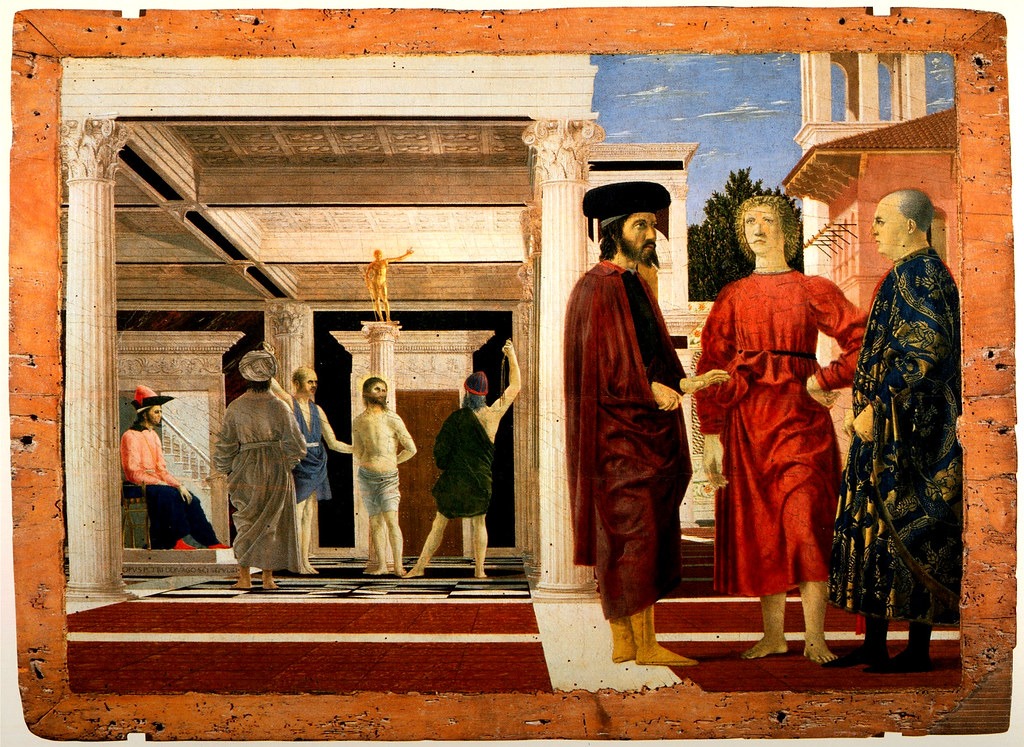
Piero was born around 1415-1420 in Borgo San Sepolcro. In this town of the upper Val Tiberina, Piero served his first apprenticeship in painting, alongside Antonio d’Anghiari: but his earliest known works show a profound understanding of early fifteenth-century Florentine art, in particular of the clear, luminous, perspectival painting of Domenico Veneziano. At this artist’s side, Piero is documented in 1439 in the Tuscan capital, as an assistant in the execution of the frescoes of the Stories of the Virgin for the choir of the church of Sant’Egidio. The masterpieces of Donatello and Masaccio left a deep and indelible mark on the young painter.
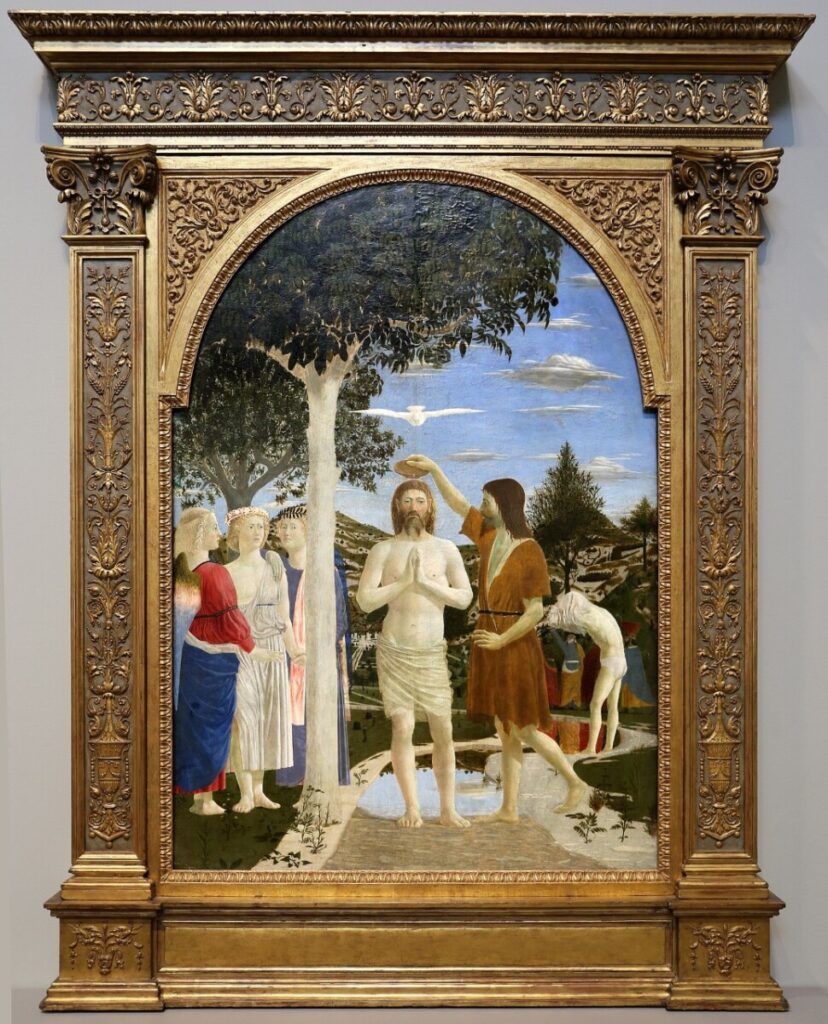
The most immediate reflections of this artistic training are found in one of Piero’s oldest surviving works, the Baptism of Christ, a scene immersed in zenithal light at the most abstract hour, noon, when shadows vanish, suspended in an enchantment of gestures and silences.
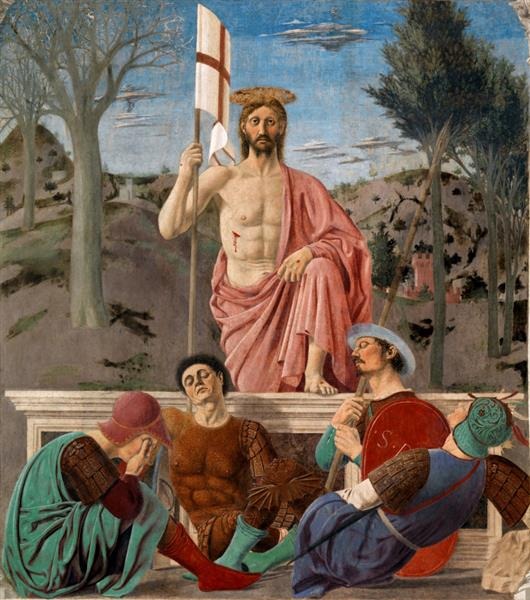
A few years later, Piero frescoed a Resurrection in Borgo Sansepolcro. In the painting, Christ, depicted with rough and essential features, at the exact center of the composition in a symbolic position, is the passage from winter, the bare trees on the left, to summer, the luxuriant trees on the right, and from the night of the soldiers asleep in front of the sarcophagus to the dawn rising above His shoulders. The risen Christ is the passage from death to life.
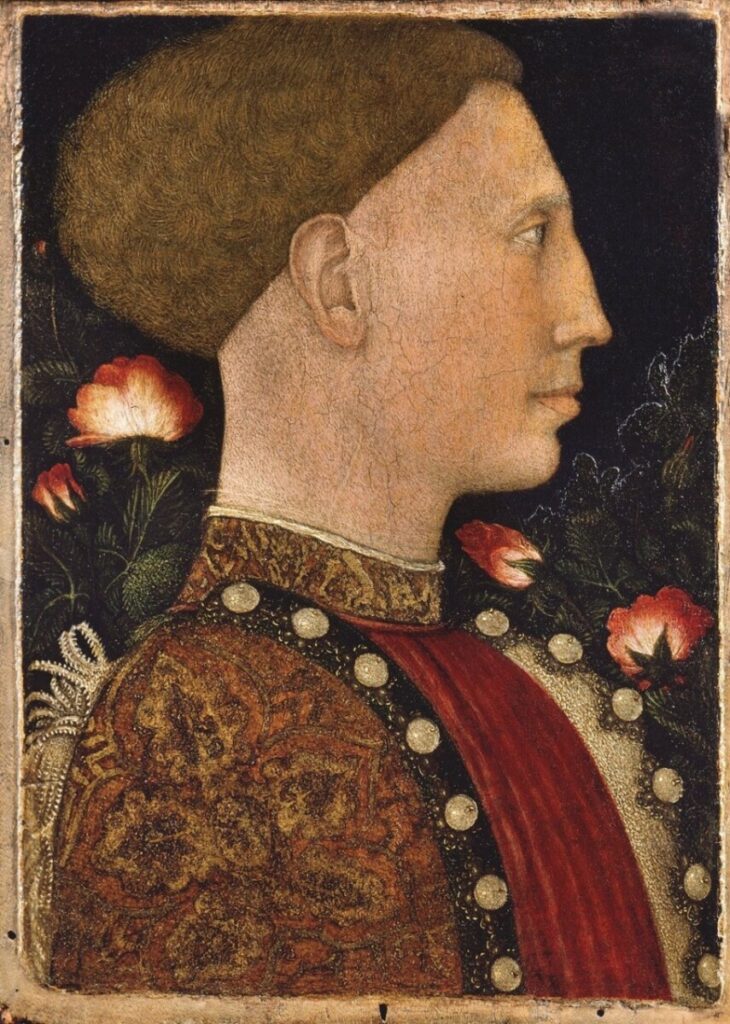
From the middle of the fifteenth century, Piero’s career unfolded in alternating stays at the principal courts of north-central Italy, in his native town, and in Ferrara, where he worked for Marquis Leonello d’Este, one of the most refined patrons of the Renaissance. It is likely that in the Romagna city the painter maintained close relations with Alberti, who must have encouraged him to pursue his passionate investigation of the laws of perspective and proportion.
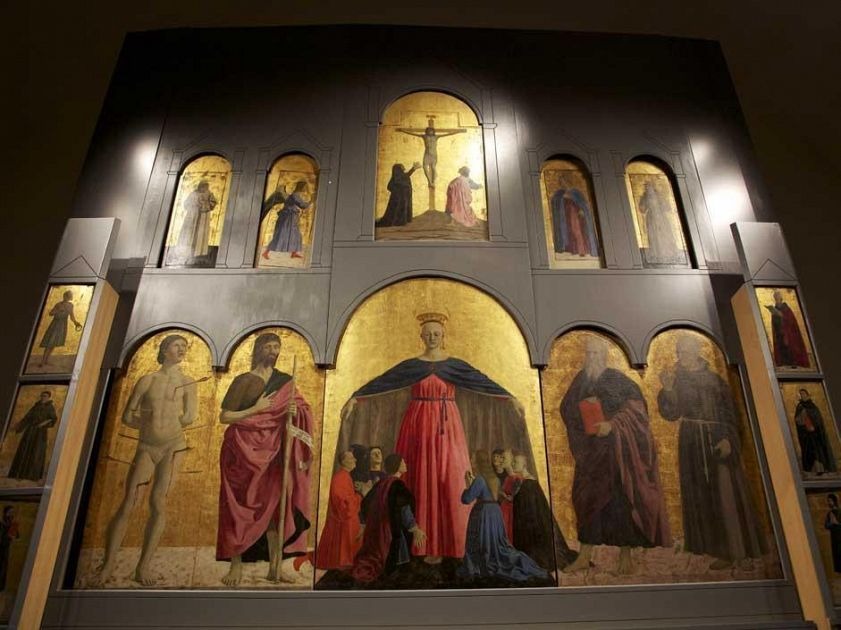
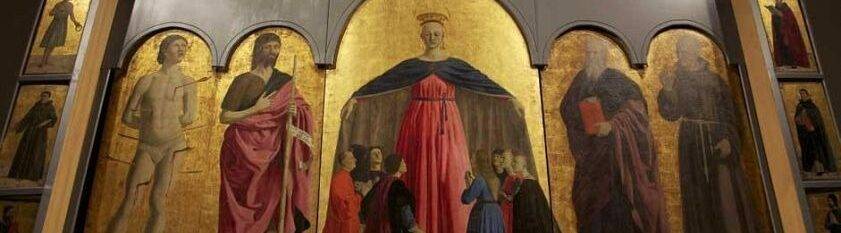
Meanwhile, in 1445, his fellow townsmen commissioned from him the great Misericordia Polyptych, on which the artist worked intermittently, delivering it, after much insistence, only in 1462: the vigorous plastic structure of the figures, immersed in a gold background, stands out for the abstract rigor of the composition and for the luminous and atmospheric value given even to the archaic gold ground.
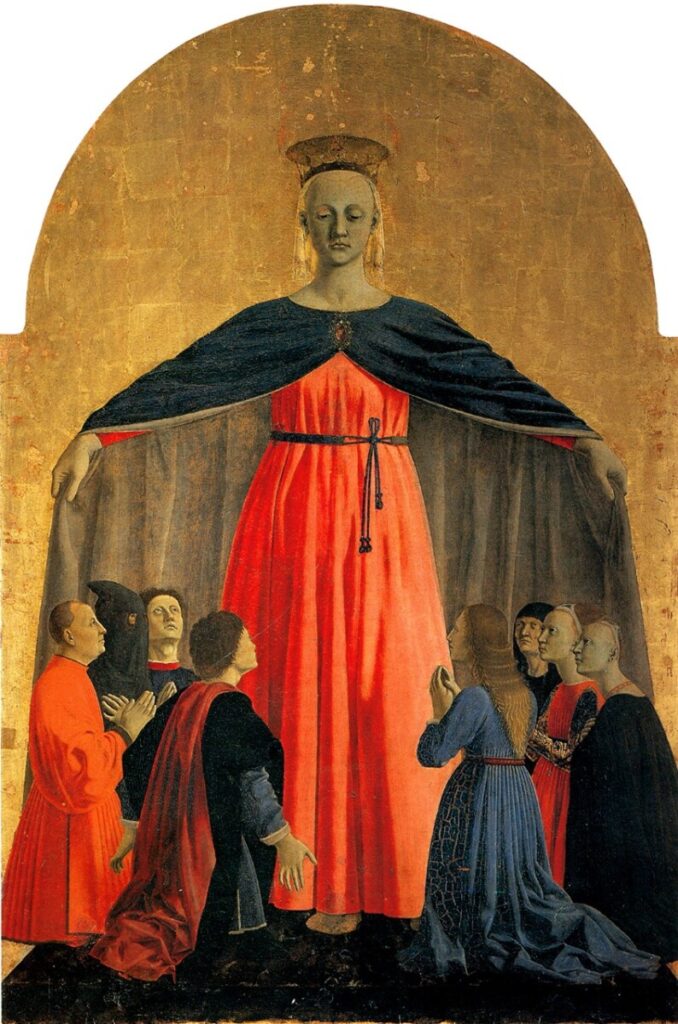
At the center of the polyptych the Mater Misericordiae shelters a group of the faithful, including Piero, in a self-portrait, the first on the Virgin’s right, and a black-hooded brother of the same confraternity that buried the dead. Mary, who wears a leather belt tied with a double cord, a reminder of her virginity, is depicted as a solid geometric volume, softened by a face that is serene, thoughtful, inspiring, and at the same time distant, transcendent, pale, and gentle. Her great mantle is a boundary, but also an apse gathered in prayer. The concessions to the archaism of the gold and to the size of the Virgin seem unable to withstand the modernity of the faces. Nevertheless, the gold becomes light, and a backlight that brings out the volumes; the play of dimensions becomes monumentality. The color is vivid, the garments sober, with rare concessions to detail, except for the Virgin’s diadem, the stones of the crown, and the arm of one of the kneeling women. It is the pure invention of a spirituality that brings man closer to the divine in the perfection of form.
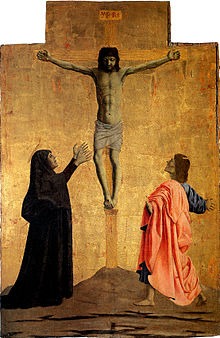
Above Our Lady, in the Polyptych, rises a Crucifixion that reaches an extreme dramatic tension in the gesture of the Mother and in the noble pose of John.
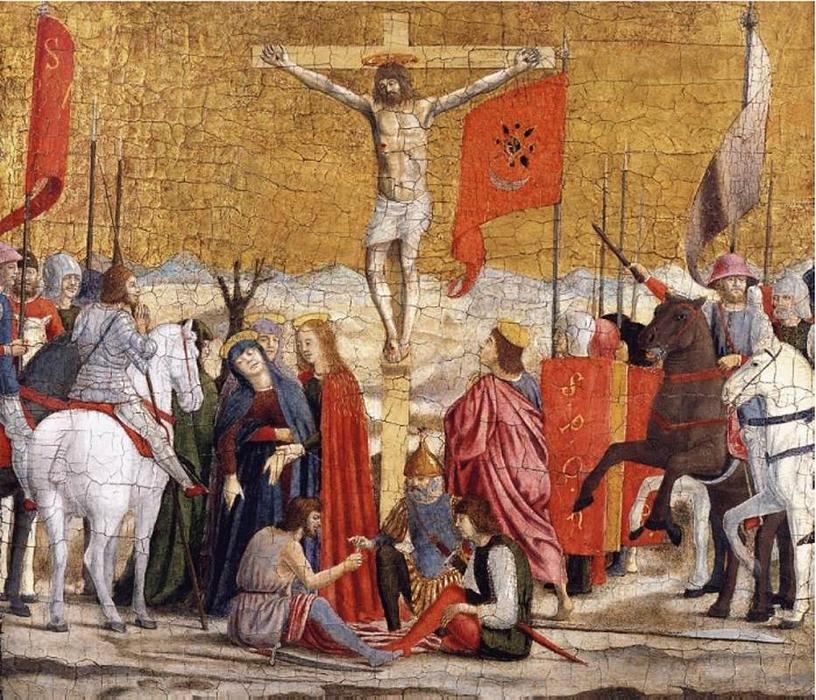
Piero paints another Crucifixion in the Saint Augustine Polyptych. The scene is organized in two hemispheres: the upper one, with a gold background, is the heavenly world, where only the Cross is found. The lower one is earthly, made up of four groups of figures. Below are three seated soldiers touching Christ’s mantle. On the left, the group of the Sorrowing Holy Women, with Saint John on the right as a counterpoint. At the two ends are two almost symmetrical groups of Roman soldiers on horseback, with steeds that resemble those of the Legend of the True Cross frescoes in Arezzo. The scene is marked by a remarkable liveliness and a chromatic richness in which the red banners, the shields, and some of the garments stand out. The emphasis on dramatic movement, through which the intense sorrow of the Mother, as well as that of Saint John, is expressed, appears exceptional in Piero’s art. Indeed, in the outstretched arms of Mary and of the disciple we could read more solemn and liturgical messages, devoid of any overwrought grief, in keeping with a composed Christ, free of violent contortions of the body.
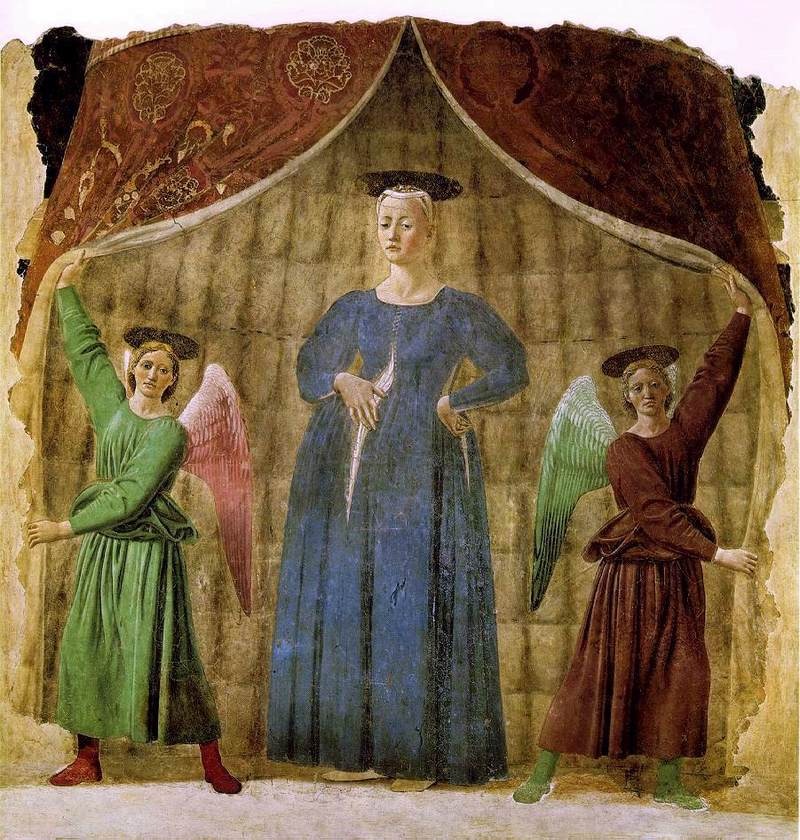
The moving Madonna del Parto dates from the late 1450s, frescoed in the cemetery chapel of Monterchi (Arezzo), where his mother was buried. Wrapped in the precious mandarin blue of her simple tunic, Holy Mary is set in a slight three-quarter pose, so that her pregnancy may be more evident. She brings her left arm to her side in an attitude of alert repose, but also of proud awareness of her condition. Her right hand touches her womb in the anxious, protective caress that every pregnant woman knows. Mary is the young peasant mother, sister of the women in labor who, generation after generation, have recognized themselves in her, but at the same time she is the Blessed One of the Lord (benedicta tu in mulieribus), the one who carries the salvation of the world.
Piero della Francesca’s capacity to analyze the truth and, at the same time, to give the sacred the vividness of a perfectly archetypal naturalism is characteristic of this painter.
Postgraduate Program in Mariology
Would you like to deepen your formation in Mariology? Discover the Postgraduate Program in Mariology of Locus Mariologicus — an academic formation that unites theological rigor, spiritual life, and the living tradition of the Church.
Would you like to study Mariology seriously?
This article grows out of the works in the Locus Mariologicus library. The Postgraduate Program in Mariology takes you to the same source, with academic guidance: Scripture, the Fathers of the Church, and the Magisterium, from the first dogma to contemporary questions.





Responses