“Mary has chosen the best part”: St. Teresa, contemplation, and Mary
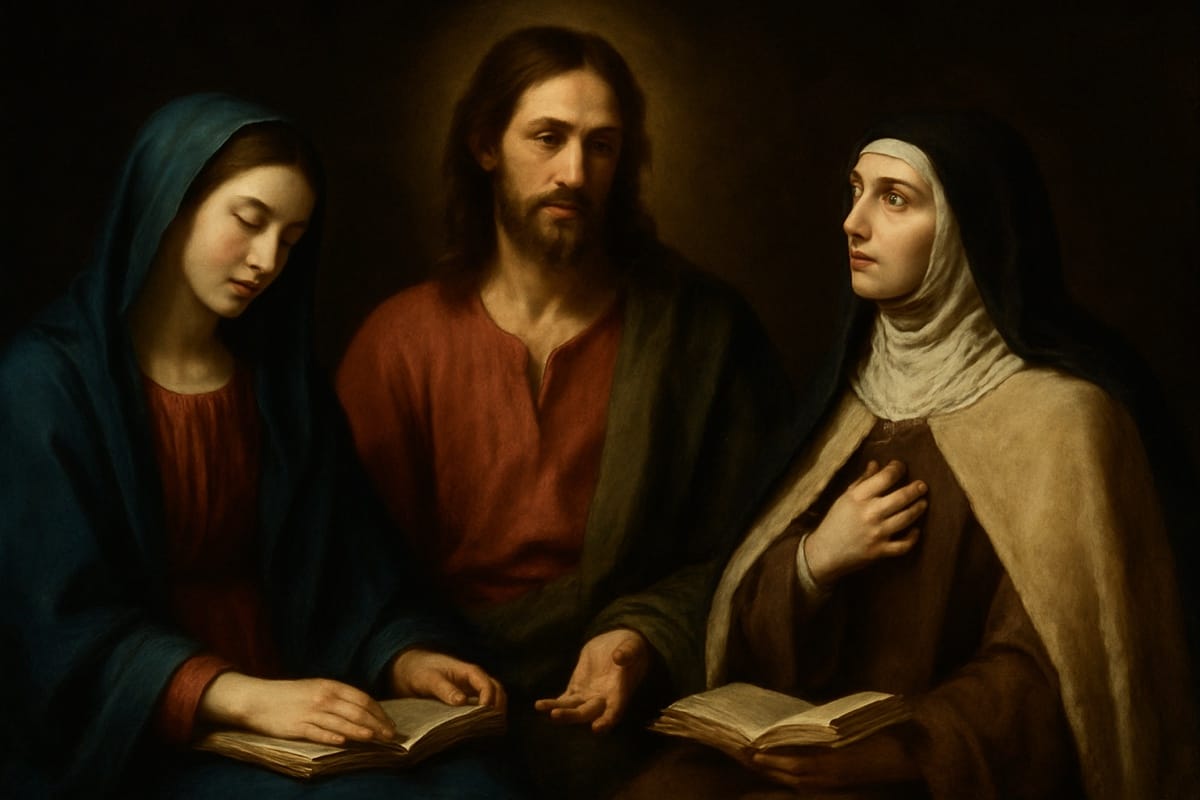
“Mary has chosen the best part, which will not be taken away from her.”
Lk 10:42b
The memory of Saint Teresa of Ávila (October 15, Doctor of the Church) joins 1 Cor 2, where Paul confesses that he came to Corinth without human eloquence but only with “Jesus Christ, and him crucified,” and describes the hidden wisdom of God revealed by the Spirit to those who love, with Lk 10, where Jesus defends Mary of Bethany who chose “the best part” by sitting at Jesus’ feet while Martha was distracted. Both texts depict the heart of Teresa’s spirituality: the contemplation of Christ crucified as the center of all interior life. Mary of Nazareth, who “kept all these things in her heart,” is the model Teresa identified as the path to authentic prayer.
I. The first reading: 1 Cor 2:1-10a
Paul admits his weakness as a preacher: “I did not come to you with persuasive words or wisdom of this age” (v.1). His only wisdom was “Jesus Christ, and him crucified” (v.2). This focus on Christ crucified is the heart of Teresa’s spirituality: in the Path of Perfection and the Interior Castle, Teresa insists that all prayer should center on Jesus Christ, especially the mystery of the Cross.
“But among those who are perfect, we speak wisdom, not of this age… but a divine wisdom, mysterious, hidden, which God predestined before the ages for our glory” (v.6-7). The wisdom Teresa attained in her exalted contemplations is not esoteric gnosis but the knowledge of Christ that Paul proclaims: “what eye has not seen and ear has not heard and has not entered into the human heart” (v.9). Authentic contemplation is always God’s gift, not a human achievement.
II. The Gospel: Lk 10:38-42
The scene of Mary and Martha provides the biblical text most directly illuminating Teresa’s vocation. Mary of Bethany who “sat at the Lord’s feet and listened to his word” (v.39) symbolizes contemplation: the posture of one who stopped, sat down, and listened. Martha, on the other hand, was distracted (“v.40”) not because her activity was bad but because it prevented her from sitting at Jesus’ feet.
“Mary chose the best part, which will not be taken away from her” (v.42): contemplation is called “the best part” not because action is bad but because contemplation endures: “it will not be taken away from her.” Christian spiritual tradition, from the Desert Fathers to Teresa of Ávila, recognizes in this verse justification for the contemplative life: knowledge of God gained through contemplation is the only thing that remains beyond death.
III. Teresa: Wisdom of the Cross in Contemplation
Teresa of Ávila is a Doctor of the Church because her teaching on prayer integrates both readings from today. Like Paul, Teresa knew “Jesus Christ and him crucified” as the center of all prayer: the Interior Castle has as its inhabitant the crucified and risen Christ, not an abstract ideal. Like Mary of Bethany, Teresa chose “the best part”: she renounced what could be taken away to obtain what remains.
The Carmelite reform that Teresa initiated is the institutional embodiment of Lk 10:42: to create spaces where “the best part” is possible, where lamps are lit and eyes are fixed on Christ. The wisdom that Paul describes as “hidden, mysterious” and to be “revealed by the Spirit” is the wisdom that Teresa described in her works: knowledge of God that can only be attained through God.
IV. Mary of Nazareth: Teresa’s Model
Teresa identified Mary of Nazareth as the supreme model for a contemplative life. In The Book of Life and The Path of Perfection, Teresa describes Mary as one who “kept all these things in her heart” (Lk 2:51), the contemplative who did not need words because the Word dwelt within her. The Bethany Mary of Lk 10 finds her perfect model in Mary of Nazareth: both sat at Jesus’ feet and listened.
Teresa’s memory invites us to recognize in Mary the path of “the best part.” Mary who received the Word in the Annunciation, who “kept” within her heart what she did not understand (Lk 2:19.51), who remained silent at the foot of the Cross while the mystery was fulfilled—this Mary is Teresa’s model and the model for all Christian contemplation: the creature who stopped, sat down, and chose the part that will never be taken from her.
Postgraduate specialisation in Mariology
Would you like to deepen your formation in Mariology? The Locus Mariologicus postgraduate programme is a specialisation that brings together theological rigour, spiritual life and the living tradition of the Church. The next class begins in 2027.





Responses