Accipite spiritum sanctum: Mary and the Gift of Pentecost
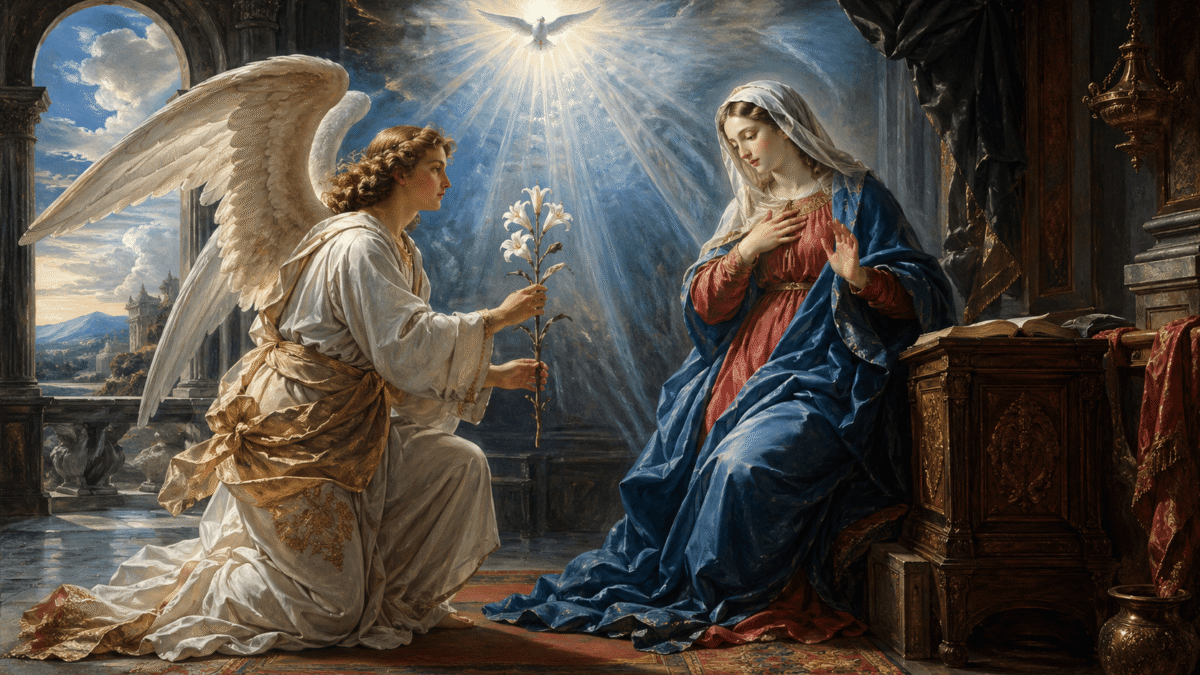
Accipite Spiritum Sanctum.
Jn 20:22
“Receive the Holy Spirit.” With these words, among the briefest and the densest in the whole of the Fourth Gospel, the Risen One breathes upon his disciples in the Upper Room and gives them the Spirit. Pentecost: the culmination of the Easter Season, the fulfillment of the promise of the Paraclete, the birth of the Church as a community animated by the Spirit of Christ. Mariology finds at this moment its broadest and deepest horizon: Mary, who was overshadowed by the Holy Spirit at the Annunciation, who “persevered in prayer” in the Upper Room awaiting the Spirit, and who was present when the Spirit descended upon the newborn Church, is the figure par excellence of the human creature who “receives the Holy Spirit” in fullness.
I. The gift of the Spirit in John: breath and new baptism
Jn 20:22 uses a gesture of enormous biblical resonance: Jesus “breathed” (enephysēsen) upon the disciples and said, “Receive the Holy Spirit.” This “breath” directly evokes Gen 2:7, the breath of God upon the clay that creates the living human being: “he formed man out of the dust of the ground and breathed into his nostrils the breath of life, and man became a living being.” The Risen One who “breathes” upon his disciples is bringing about a new creation: the “Adam” of the new world that emerges from death, the risen Christ, breathes the breath of new life upon the new “Adams” who are his disciples.
The connection with the creating breath of Gen 2:7 has a direct Mariological dimension. Mary, who was created with the fullness of grace (“full of grace,” Lk 1:28), participated in a unique way in this “new creation” that the Risen One brings about. She who was the first human creature completely configured to the Son by the Spirit, in the Immaculate Conception and at the Annunciation, is also the first to participate fully in the new creation that the Risen One inaugurates with his breath.
The correspondence between Jn 20:22 and Acts 2 (Luke’s Pentecost) is a datum of biblical theology that scholars debate: John narrates the gift of the Spirit on the day of the Resurrection. Luke narrates it fifty days later. The tradition resolved the apparent contradiction by distinguishing an “initial” gift of the Spirit (Jn 20) and a “full and public” manifestation of the Spirit (Acts 2). At both moments, Mary was present: in the Upper Room of the Risen One (Jn 20:19-23, implicitly) and in the Upper Room of Pentecost (Acts 1:14; 2:1-4).
The sacramental formula of Confirmation in the Roman liturgy, “Be sealed with the Gift of the Holy Spirit,” is a direct echo of Jn 20:22. Every confirmed believer “receives the Holy Spirit” with the authority of the Risen One who breathed upon his disciples. And Mary, “full of grace” and “filled with the Holy Spirit,” is the model of one who received this gift most fully, without obstacle, without resistance, with total openness to the breath of the Risen One.
II. Mary “Filled with the Holy Spirit”: model of receptivity
Lk 1:35: “The Holy Spirit will come upon you, and the power of the Most High will overshadow you.” Mary’s “receptivity” to the Spirit, which the Annunciation inaugurates, is the central theme of her Mariological identity. She does not “conquer” grace, she does not “earn” the Spirit by her merits, she “receives”: this is perfect receptivity, the “vessel” open to the divine gift without obstacle. The “Accipite Spiritum Sanctum” that the Risen One addresses to the disciples in the Upper Room finds in Mary its antitype and its consummation.
The Franciscan tradition developed this theme fruitfully: Duns Scotus, in defending the Immaculate Conception, argued that “preservation from sin” is a more perfect form of redemption than “liberation from sin.” Mary was not “set free” from sin, she “was preserved” from it, which means that the gift of the Spirit found her from the first instant without the resistance that original sin produces. This maximal receptivity, “the most excellent fruit of the redemption,” is what makes Mary the most perfect “receiver” of the Holy Spirit.
The spirituality of “kenosis,” the “emptying” of oneself in order to be “filled” with God, finds in Mary its most radical model. She who said “let it be done to me” (Lk 1:38) expressed the total emptying of the “I” that makes the fullness of the Spirit possible. This “kenosis” of Mary is not the negation of her identity, it is its highest realization: she who “emptied” herself in the service of the Son is the one who was most completely “filled” with the Spirit.
Devotion to the Immaculate Heart of Mary, which the message of Fatima placed at the center of the Marian spirituality of the twentieth century, is the devotional expression of this receptivity. The “Immaculate Heart” is the heart without obstruction, the heart that received the Spirit without the crust of selfishness that most human hearts progressively form. To consecrate oneself to the Immaculate Heart of Mary is to ask that her receptivity to the Spirit be communicated to those who invoke it, that the Spirit who dwelt in her without obstacle may begin to dwell in us as well, progressively tearing down the resistances that stand in the way of his breath.
III. Pentecost and mission: Mary, Mother of the missionary Church
Acts 2:1-11 narrates Pentecost as the event that transforms the fearful into the courageous, the disciples shut up in the Upper Room into missionaries who go out into the streets of Jerusalem. “They were all filled with the Holy Spirit,” and immediately “began to speak in other tongues” (Acts 2:4). The gift of the Spirit is the gift of mission: not to be enjoyed in enclosure, but to proclaim “the mighty acts of God” (Acts 2:11) to all who hear. The Johannine “Accipite Spiritum Sanctum” becomes here, in the Lucan account, a universal missionary force.
Mary, who was present at this inaugural Pentecost, is the Mother of the missionary Church that the Spirit brings forth. Paul VI, in proclaiming her “Mater Ecclesiae” (1964), expressed this missionary dimension of her motherhood: she who brought the Son forth to the world is now the Mother of the Church that continues to “bring forth” the Son to the world in every generation. The mission of the Church is not separable from Mary’s motherhood: as she “brought forth” the Son for the world in the Incarnation, the Church “brings forth” the Son for the world in the sacraments, in catechesis, in charity.
The tongues of Pentecost, which the miracle of tongues had made accessible to people of every nation (Acts 2:5-11), have a Marian dimension that the tradition has rarely explored: all the languages in which the Gospel has been proclaimed descend from the first language of the Gospel, which is Mary’s “fiat.” The Good News began when Mary said “yes.” All the other “Gospels” are an echo and a development of that first “yes.” The tongues of Pentecost are the universal unfolding of the particular “fiat” of Mary of Nazareth.
The mission of the Church in the twenty-first century, the “new evangelization” of cultures that were Christian and have become secularized, and the “first evangelization” of peoples who have not yet heard the Gospel, has a Marian heart. The great missionary undertakings of Christian history, the Jesuit missions of the sixteenth and seventeenth centuries, the missions of Saint Francis Xavier, the Marian missions of Saint Louis Marie de Montfort, the contemporary missions of the ecclesial movements, share a Marian profile: the presence of Mary at the center of mission is not ornamental, it is structural. She who brought the Son forth for the world is the model and the intercessor of all who seek to continue this “bringing forth” of the Son in the world.
IV. “Receive the Holy Spirit”: the gift that completes the Easter Season
Pentecost is not the end of the Easter Season, it is its culmination and the beginning of a new time: the “time of the Church,” the time of the Spirit, the time in which the promise of the Risen One is fulfilled in every generation. Jn 20:22, “Receive the Holy Spirit,” is the sentence that all who have been baptized can apply to themselves: they “received” the Spirit in Baptism, “strengthened” this gift in Confirmation, and continually “renew” this reception in the Eucharist and in prayer. The “Accipite Spiritum Sanctum” is not a word spoken only once, but a gift that is renewed in every celebration and in every available heart.
Mary, who “received the Holy Spirit” more fully than any other human being, from the Annunciation to Pentecost, is the model of this continual reception. She did not “receive” the Spirit once and keep him in reserve: she lived her whole life in an ever-renewed receptivity to the Spirit who dwelt within her. This dynamism, to receive without ceasing to receive, to be “filled” without becoming “full of herself,” is the model of the Christian spiritual life that Pentecost inaugurates.
The eschatology of Pentecost points to the Spirit as the “pledge” (arrabōn, Eph 1:14) of the future fullness: the Spirit given now is the anticipation and the guarantee of what the fullness of the Kingdom will be. Mary glorified in the Assumption is already in that fullness, and her glorification in body and soul is the sign that the promise of Pentecost will reach its definitive fulfillment. The Spirit who “groans” in us “with inexpressible groanings” (Rom 8:26) awaiting the full revelation of the children of God has already completed his work in Mary: she who is glorified is the guarantee that the “pledge” we received at Pentecost will become full possession.
The Easter Season ends with Pentecost, but the mission that Pentecost inaugurates does not end. The Church that has received the Spirit “goes” out to the world: she proclaims, baptizes, celebrates, serves. And Mary, who was at the heart of it all, from the Annunciation to the Assumption, from the Incarnation to Pentecost, continues to be at the heart of it all: interceding, accompanying, bringing forth new children for the Son, presenting to the Son those whom the world brings to her, presenting to the world the Son whom she brought forth. “Do whatever he tells you” (Jn 2:5): this is Mary’s last word in the Gospels, and it is the first and the last word of Marian spirituality for all time.
Mary, who “received the Holy Spirit” in fullness and who was present at the inaugural Pentecost, is the heart of the missionary Church that the Spirit continually brings forth: the Mother who brought the Son forth to the world and who continues to bring him forth in every generation.
References
- John Paul II, Redemptoris Mater, nos. 26-27 (1987).
- Paul VI, Address at the closing of the third session of the Second Vatican Council (1964).
- Second Vatican Council, Lumen Gentium, nos. 59-65 (1964).
- R. Laurentin, L’Esprit Saint et Marie (1975).
- H. U. von Balthasar, Mary for Today (1987).
Postgraduate Program in Mariology
Would you like to deepen your formation in Mariology? Discover the Postgraduate Program in Mariology at Locus Mariologicus – an academic formation that unites theological rigor, spiritual life, and the living tradition of the Church.
Would you like to study Mariology seriously?
This article is born of the works in the Locus Mariologicus library. The Postgraduate Program in Mariology takes you to that same source, with academic guidance: Scripture, the Fathers of the Church, and the Magisterium, from the first dogma to contemporary questions.




Responses