Who is Bernard of Clairvaux?

Bernard of Clairvaux (1090-1153): the last of the Fathers and the doctor of affectionate Marian theology
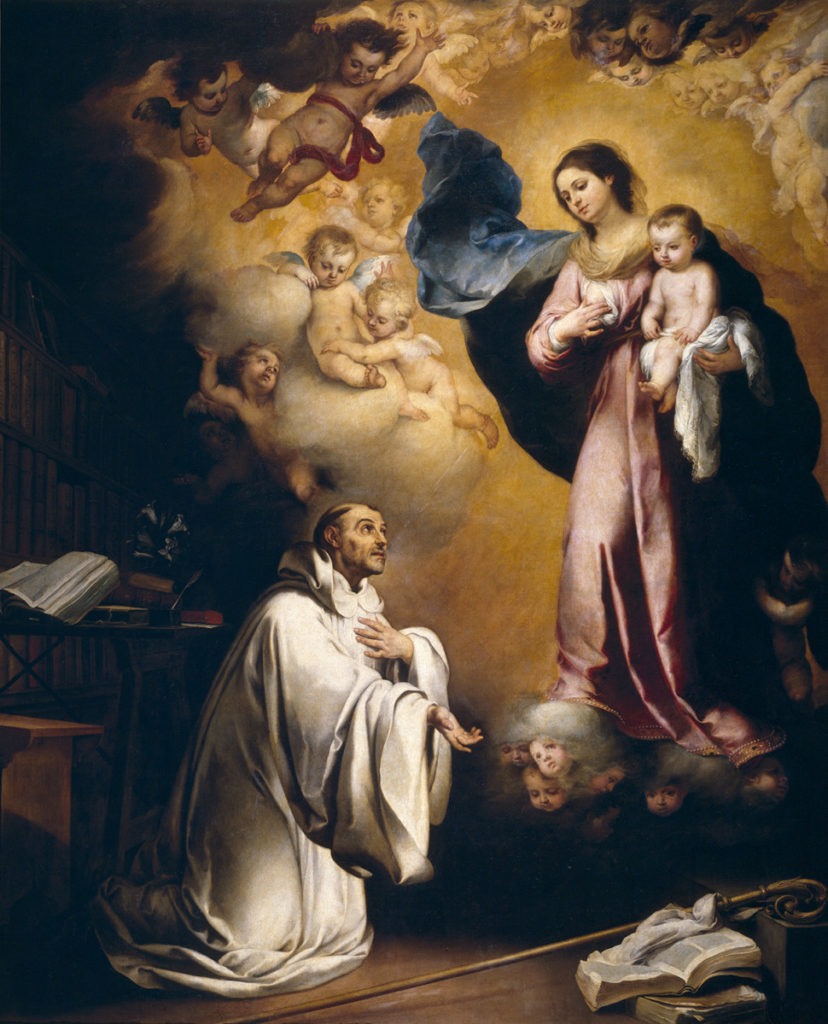
Bernard of Clairvaux is, without doubt, the most illustrious exponent of the Cistercian family, as well as a theologian who left a strong mark on later thought, even outside the Order. The son of a knight, Bernard was born in 1090 in Burgundy and entered Cîteaux at the age of 22, a place of monastic renewal. After three years, he was sent with other brothers to found the monastery of “Claravalle,” which he placed under the patronage of the Virgin, building a chapel in her honor. He remained in this monastery, where he was later elected abbot, until 1153, the year of his death. Besides the development of the Order, in which he exercised his strong and charismatic presence, he also took care of difficult questions: easing the conflicts between the powerful and preventing the interference of lay princes in ecclesiastical religion. He insisted on the unity of the Church at heart and was a counselor of popes and bishops. A full life, therefore, in which the cloistered life alternated with ecclesial and secular service. All of it offered to the Virgin because, as he himself mentions in the homily for the Nativity of Our Lady, “it must be remembered that, if one does not want the little that one wishes to offer to be refused, one should seek to entrust it to the most kindly and worthy hands of Mary.”
The historical-interpretative and descriptive view of Bernard’s work is already very condensed, resulting in the formation of two currents of thought that confronted each other over the importance of our author’s Marian theology. If on the one hand we had an unconditional applause for Bernard’s Marian thought, to the point of conferring on him the title of Marian Doctor, on the other hand there was a reduction of this uncritical stance without, however, undermining the originality of the greatest Cistercian author of the early period. Density and fervor, besides the numerical quantity of the writings, are the characteristic traits of Bernard’s Marian thought, the author of a much broader and more articulated theology.
What perhaps harmed this author was a series of works that, after his death, were attributed to him, inflating an authentic number that in itself was not inflated. In the pages dedicated to this author in the great study edited by Du Manoir, J. B. Auniord lists Bernard’s Marian writings: the four Marian homilies (In Laudibus Beatæ Mariæ Virginis), the letter to the Canons of Lyon on the Immaculate Conception, the homily of the Sunday of the Octave of the Assumption on the 12 Marian prerogatives, the homily on the Nativity of Mary (Sermo De aquæductu), the first homily of the Assumption, and the fourth homily on the Assumption. To these texts are added other references to the Mother of God in other homilies that are not directly Marian. The overcoming of the quantitative question is offered to us by a clarification made by L. Gambero, according to which:
Bernard’s Marian pages may seem scarce, if compared to the considerable quantity of his writings. Nevertheless, they show all the genius and theological wisdom of the great Doctor, his impassioned style, his capacity to incorporate the reference to Mary into the culture of his time, and his zeal in spreading devotion to the Mother of God among the Christian people.
Before going into detail about the Marian themes treated by the Cistercian, it is fitting to specify an existential aspect that influences his style and his approach to Mary. Bernard is the last great exponent of monastic theology, clearly oriented toward the contemplation and meditation of the divine mysteries, rather than toward their illustration by means of philosophical categories. Nevertheless, this does not mean the death of that kind of theology. In fact, as an author, Bernard left so strong a mark that not a few exponents of theology and spirituality, belonging to the following centuries and by then inserted into a kind of argumentative and rational theology, drew inspiration from him. Above all, Saint Bonaventure.
His monastic vocation and his contemplative orientation, before making him a doctor (in the late medieval and modern sense of the term), made him a devotee of the Virgin. Indeed, according to Alan of Auxerre († 1185), the saint’s biographer, a devoted minister. Peter of Celle, then, writing to Nicholas of St Albans, defines Bernard “alumnus familiarissimus Dominae nostrae,” thus underlining the filiation (the former pupil is already understood as a son) and the intimacy (familiarissimus indicates a bond that goes beyond affection) with Our Lady (that is, a relationship conditioned by the feudal system, between lord and servant), of whom one is a servant, but also and above all a son.
Devout and affective Marian theology takes concrete form in a particularly refined and poetic literary style, in such a way as to preclude the pursuit of systematicity and completeness. To this is added a feeling of wonder and a profound awareness of the human limit before God, for which silence is preferable to words. Here are two texts that help us to express this feeling of wonder in Bernard:
There is nothing I like more and at the same time that frightens me more than to give a sermon on the glory of the Virgin Mother. (…) Although everyone wants to speak of her, nevertheless what is said of an ineffable reality becomes, by the very fact of being said, less dear and less accepted.
In the Second Sermon of the Annunciation (In Laudibus Virginis Matris), after having exalted the Virgin with the title of star (Stella maris), Bernard assumes an attitude similar to that of the disciples present at the Transfiguration of the Lord:
But now we must make a short pause, so that the contemplation of the splendor of this light may not be fleeting. To use the words of the apostles: “It is good for us to be here.” And we like to contemplate gently in silence what an elaborate discourse is not sufficient to explain. Meanwhile, through the devout contemplation of the shining star, more fervent commentaries will be prepared on the following themes.
Bernard, therefore, prefers contemplative silence to elaborate discourse (of which, for example, Abelard or Peter Lombard would have been champions), and he likes to pronounce a few more titles of praise, rather than wanting to penetrate the mystery of God with reasoning. We have, therefore, contemplation, silence, but also formation, because the Virgin Mary becomes for Bernard the ideal of monastic life and, as such, he proposes her to his brothers and to the whole Christian people.
One of the terms present in Bernard’s writings is inventrix (she who finds), modeled on the text of Lk 1:30. Mary is worthy to find what she seeks, but not only that. In this aspect too we see the extraordinary character of this mulier who is fully enveloped in the grace of God and, at the same time, is one who asked for and obtained a supplement of grace. And here we have a strong pedagogical reason: it must place Mary in search of this grace that she needed. In this term (she who finds) there converge the greatness of Mary, her mediating strength, but also the impetus of Christians. Thus, it is possible to perceive how we are faced with a rather emotional kind of mariological reflection, where feelings prevail. But this does not eliminate the proper view of the whole of Revelation, carried out with the gaze of the devout and of the mystic, more than of the scholar who allows the action of reason applied to the sacred and to the mystery to prevail, also in good faith and with a spirit of service.
May it be given to us, after the example of Saint Bernard of Clairvaux, to look upon the Virgin with devotion and mysticism, but also with a special theological science. Mary is “she who finds” grace and also seeks and needs Grace.
To deepen the Marian devotion inspired by Saint Bernard, the apostolic exhortation Marialis Cultus by Paul VI is recommended.
Deepen your studies: explore Mariology, Marian Theology, Marian apparitions, and the Postgraduate Program in Mariology.
Postgraduate Program in Mariology
Would you like to deepen your formation in Mariology? Discover the Postgraduate Program in Mariology at Locus Mariologicus, an academic formation that unites theological rigor, spiritual life, and the living tradition of the Church.




Responses