Via Matris: what it is and how to pray the seven sorrows of Mary

The Via Matris (“way of the Mother”, from the Latin matris, genitive of mater) is the exercise of piety that traverses in seven stations the seven sorrows of Our Lady, from the prophecy of Simeon (Lk 2:34-35) to the burial of Jesus. Modeled on the Way of the Cross, approved by the Apostolic See and spread by the Servants of Mary, it is also called Via Matris dolorosae.
Those who pray the Via Matris accompany the Virgin from the childhood of Jesus to Calvary and the tomb, and learn from her to live sorrow in faith. Below you will find what the devotion is according to the Directory on Popular Piety and the Liturgy (nos. 136-137), the seven stations with the Bible passage for each one checked against the original Greek, a practical guide to praying it, its relationship with the Way of the Cross, with the Stabat Mater and with the memorial of Our Lady of Sorrows (September 15), and the history of the devotion among the Servants of Mary.
What the Via Matris is
The word via means “way” and matris is the genitive singular of mater, “mother”. Via Matris is therefore “the way of the Mother”, and the full form Via Matris dolorosae means “the way of the sorrowful Mother”. Just as the Way of the Cross (Via Crucis, “way of the cross”) accompanies Jesus station by station, the Via Matris accompanies Mary through the seven moments in which Christian tradition has recognized her principal sorrows.
The Church document that describes the devotion is the Directory on Popular Piety and the Liturgy, published in 2002 by the Congregation for Divine Worship and the Discipline of the Sacraments. In no. 136, after recalling that Christian piety has distinguished seven sorrowful episodes in the life of the Virgin, the official Italian text states that “sul modello della Via Crucis, è sorto il pio esercizio della Via Matris dolorosæ o semplicemente Via Matris, anch’esso approvato dalla Sede Apostolica”, that is, on the model of the Way of the Cross there arose the pious exercise of the Via Matris, which has likewise been approved by the Apostolic See (our translation). The Directory’s note refers to the apostolic letter Deiparae perdolentis of Leo XIII.
The same number sums up the underlying insight: to consider the whole life of the Virgin, from the prophetic announcement of Simeon to the death and burial of her Son, as a way of faith and sorrow, articulated in seven “stations” that correspond to the seven sorrows of the Mother of the Lord. That is why the Via Matris is not a sentimental devotion: it is a prayerful reading of the Gospel, in which Mary appears, in the words of the Directory, as socia passionis, the Mother whom God willed to associate with the Passion of the Son.
The seven sorrows of Mary: the seven stations of the Via Matris
The seven stations follow the chronological order of the Gospels. The first four sorrows belong to the childhood and life of Jesus, the last three to Calvary. For each station we give the Bible passage and, when the text allows it, the original Greek (SBLGNT) with a literal translation. The sorrows of Mary are studied in depth in Our Lady of Sorrows: the seven sorrows of Mary and the theology of compassion. Here the focus is on praying them as a way.
| Station | Sorrow of Mary | Bible passage |
|---|---|---|
| 1st | The prophecy of Simeon | Lk 2:34-35 |
| 2nd | The flight into Egypt | Mt 2:13-15 |
| 3rd | The loss of the Child Jesus in Jerusalem | Lk 2:43-48 |
| 4th | The meeting with Jesus on the way to Calvary | cf. Lk 23:26-27 |
| 5th | Mary at the foot of the cross and the death of Jesus | Jn 19:25-30 |
| 6th | The descent from the cross: Mary receives the body of her Son | Jn 19:38-40, Mt 27:57-59 |
| 7th | The burial of Jesus | Jn 19:40-42, Mt 27:59-60 |
1st station: the prophecy of Simeon (Lk 2:34-35)
In the Temple, forty days after the birth, the aged Simeon takes the Child in his arms and turns to the Mother. He says that the Son will be “εἰς σημεῖον ἀντιλεγόμενον”, “a sign spoken against”, and adds:
“καὶ σοῦ δὲ αὐτῆς τὴν ψυχὴν διελεύσεται ῥομφαία” (Lk 2:35), literally: “and through your own soul also a sword will pass”.
The Greek insists on the pronoun (σοῦ δὲ αὐτῆς, “your own”): the sword that strikes the Son also pierces the Mother. The ῥομφαία is the great sword, with a long blade. The Vulgate translates “et tuam ipsius animam pertransiet gladius” (Nova Vulgata, Lk 2:35), a phrase the Stabat Mater will take up. The Directory (no. 136) says that, from the childhood of Christ, the whole life of the Virgin unfolded under the sign of that sword. It is the sorrow that opens all the others.
2nd station: the flight into Egypt (Mt 2:13-15)
“Ἐγερθεὶς παράλαβε τὸ παιδίον καὶ τὴν μητέρα αὐτοῦ καὶ φεῦγε εἰς Αἴγυπτον” (Mt 2:13), literally: “rising, take the child and his mother and flee into Egypt”.
Herod is seeking the Child to kill him. Joseph obeys by night (Mt 2:14) and Mary sets out with him into exile, to a foreign and uncertain land. It is the sorrow of the Mother who sees the life of her Son threatened from the cradle, and the sorrow of all persecuted and refugee families.
3rd station: the loss of the Child Jesus in Jerusalem (Lk 2:43-48)
After the Passover in Jerusalem, Jesus, at twelve years of age, stays behind in the city without his parents knowing. For three days Mary and Joseph search for him. On finding him in the Temple, Mary says:
“ἰδοὺ ὁ πατήρ σου καὶ ἐγὼ ὀδυνώμενοι ἐζητοῦμέν σε” (Lk 2:48), literally: “behold, your father and I, in anguish, were seeking you”.
The participle ὀδυνώμενοι comes from ὀδυνάομαι, “to suffer acute pain”, the same verb Luke uses for the torment of the rich man in the parable (Lk 16:24-25). The three days of searching prefigure the three days of the tomb. It is the sorrow of one who does not understand the ways of God and, even so, keeps everything in her heart (Lk 2:51).
4th station: the meeting with Jesus on the way to Calvary (cf. Lk 23:26-27)
The Gospels do not explicitly narrate Mary’s meeting with Jesus on the Via Dolorosa. Luke records that, while Simon of Cyrene carried the cross behind Jesus,
“Ἠκολούθει δὲ αὐτῷ πολὺ πλῆθος τοῦ λαοῦ καὶ γυναικῶν αἳ ἐκόπτοντο καὶ ἐθρήνουν αὐτόν” (Lk 23:27), literally: “there followed him a great multitude of the people and of women who beat their breasts and lamented him”.
Christian piety, knowing from John that the Mother was standing by the cross (Jn 19:25), contemplated the moment in which she meets her Son on the way. It is also the fourth station of the Way of the Cross. Out of biblical honesty, the station rests on a certain fact (Mary was on Calvary) and on a contemplation of tradition (the meeting on the way).
5th station: Mary at the foot of the cross and the death of Jesus (Jn 19:25-30)
“Εἱστήκεισαν δὲ παρὰ τῷ σταυρῷ τοῦ Ἰησοῦ ἡ μήτηρ αὐτοῦ” (Jn 19:25), literally: “there were standing by the cross of Jesus his mother”.
Mary is standing. From the height of the cross, Jesus entrusts her to the beloved disciple: “Γύναι, ἴδε ὁ υἱός σου”, “Woman, behold your son”, and to the disciple: “Ἴδε ἡ μήτηρ σου”, “Behold your mother” (Jn 19:26-27). Then He says “Τετέλεσται”, “it is finished”, and gives up His spirit (Jn 19:30). This is the center of the Via Matris: Simeon’s sword reaches the depths, and in the same hour Mary receives motherhood over the disciples. The theology of this scene is developed in “Stabat autem iuxta crucem”: Mary’s compassio.
6th station: the descent from the cross (Jn 19:38-40)
“ἦλθεν οὖν καὶ ἦρεν τὸ σῶμα αὐτοῦ” (Jn 19:38), literally: “he came, then, and took away his body”.
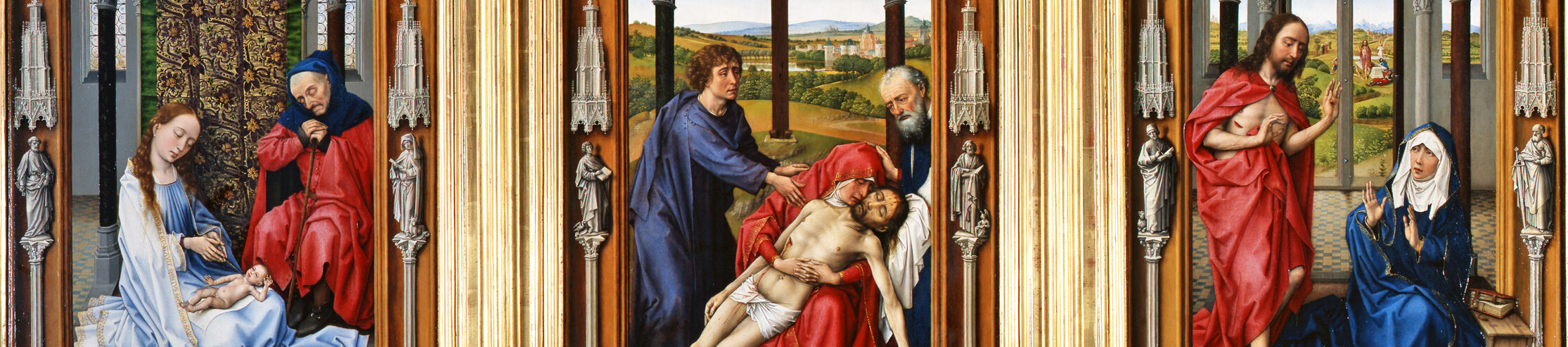
Joseph of Arimathea obtains the body of Jesus from Pilate (Mt 27:57-58). The Gospels do not describe Mary receiving her dead Son, but tradition, contemplating the Mother who stood at the foot of the cross, gave this scene the form of the Pietà. The Directory (no. 137) says that the Via Matris finds in the Pietà its highest expression: “La Via Matris ha come massima espressione la “Pietà”, tema inesauribile dell’arte cristiana sin dal Medioevo”, that is, the Via Matris has as its highest expression the Pietà, an inexhaustible theme of Christian art since the Middle Ages (our translation).
7th station: the burial of Jesus (Jn 19:40-42)
“ἐν τῷ κήπῳ μνημεῖον καινόν… ἐκεῖ οὖν… ἔθηκαν τὸν Ἰησοῦν” (Jn 19:41-42), literally: “in the garden, a new tomb… there, then… they laid Jesus”.
The body is wrapped in linen cloths with spices and placed in a new tomb, in a garden, and a great stone closes the entrance (Mt 27:60). Mary returns without her Son. It is the sorrow of the silence of Holy Saturday, lived, however, in hope: the garden of the tomb will be the garden of the Resurrection (Jn 20:15).
How to pray the Via Matris: a step-by-step guide
There is no single, obligatory formula: the aids published by parishes, shrines and communities of the Servants of Mary vary in their prayers. What is essential, according to the Directory, is the way in seven stations with the contemplation of the sorrows in the light of the Gospel. A simple outline, which you can pray alone, as a family or in a group, is this:
- Opening. Make the sign of the cross and a brief prayer asking for the grace to accompany Mary on the way of her Son. If you pray in a church that has the stations, you may move from one to the next, as in the Way of the Cross.
- Announcing the station. Say the number and the name of the sorrow (for example: “First station: the prophecy of Simeon”).
- Gospel reading. Read aloud the passage indicated in the table above. It is the heart of each station.
- Silence and meditation. One or two minutes of silence. Ask yourself how Mary lived that sorrow and where it touches your own life.
- Prayer. Pray an Our Father and a Hail Mary, or a stanza of the Stabat Mater. You may add an intention for those who suffer something similar (exiles, parents who have lost children, the sick, the bereaved).
- Repeat the same outline at the seven stations.
- Conclusion. End with the Hail Holy Queen and the sign of the cross, remembering that the sorrows of Mary are illumined by Easter: after the tomb comes the Resurrection.
How long it takes: about 20 to 30 minutes, depending on the time of silence. When to pray it: the Directory (no. 137) says that the Via Matris harmonizes well with Lent, because the sorrows of the Virgin arise from the rejection of her Son by men. It is customary to pray it on Fridays and Saturdays, on the days that prepare for or prolong the memorial of Our Lady of Sorrows (September 15), and in times of mourning, illness or desolation.
Via Matris and the Way of the Cross: what is the difference
The Via Matris was born in imitation of the Way of the Cross, but it does not repeat it. The two devotions complement each other.
| Way of the Cross (Via Crucis) | Via Matris | |
|---|---|---|
| Who is accompanied | Jesus | Mary, united to her Son |
| Number of stations | 14 (traditional) | 7 |
| Period contemplated | From the condemnation to the burial | From the childhood of Jesus (Lk 2) to the burial |
| Stations in common | The meeting on the way to Calvary, the death on the cross, the descent from the cross and the burial | |
| Most fitting time | Lent, especially Fridays | Lent, Fridays and Saturdays, September (9/15) |
The decisive difference is the gaze. In the Way of the Cross we contemplate the Son who suffers. In the Via Matris we contemplate the same mystery with the heart of the Mother who suffers with Him. That is why the Directory says that the Via Matris “rinvia costantemente e necessariamente al mistero di Cristo servo sofferente del Signore”, refers constantly and necessarily to the mystery of Christ, the suffering Servant of the Lord (no. 137, our translation).
Origin of the Via Matris: the Servants of Mary
The exact origins of the Via Matris are not well known. The Directory gives the reliable framework: “Forme embrionali della Via Matris sono individuabili fin dal secolo XVI, ma nella sua forma attuale, essa non risale oltre il secolo XIX”, that is, embryonic forms have existed since the sixteenth century, but the present form does not date from before the nineteenth century (no. 136, our translation). The devotion grew in the setting of the devotion to the seven sorrows typical of the Order of the Servants of Mary (Servites), which became its great propagator.
Ecclesial recognition came from the Apostolic See: the Directory’s note to no. 136 refers to the apostolic letter Deiparae perdolentis of Leo XIII. The origin of the devotion to the sorrows and of its liturgical feast is told in Origin of Our Lady of Sorrows.
Via Matris and Stabat Mater
The hymn most closely linked to the Via Matris is the Stabat Mater, a medieval poem of disputed authorship (often attributed to the Franciscan Jacopone da Todi). It begins thus:
“Stabat Mater dolorosa / juxta Crucem lacrimosa, / dum pendebat Filius. / Cujus animam gementem, / contristatam et dolentem, / pertransivit gladius.”
In literal translation: “The sorrowful Mother stood by the cross, weeping, while her Son hung there. Her groaning soul, saddened and grieving, a sword pierced.” The first line echoes Jn 19:25 (stabat, “was standing”), and the sixth fulfills, in the past tense (pertransivit, “pierced”), the prophecy of Simeon that the Vulgate gave in the future (pertransiet, “will pierce”, Lk 2:35). That is why the hymn, which continues to be sung between the stations of the Way of the Cross, lends itself equally to accompanying the stations of the Via Matris. In the liturgy, the hymn entered as the sequence of the Mass of the Sorrows of Mary in 1727 and today is optional on the memorial of September 15.
Our Lady of Sorrows: the memorial of September 15
The Church celebrates the liturgical memorial of Our Lady of Sorrows on September 15, the day after the feast of the Exaltation of the Holy Cross. Saint Paul VI, in the exhortation Marialis cultus, calls it “a fitting occasion for reliving a decisive moment in the history of salvation and for venerating, together with the Son ‘lifted up on the cross, the Mother who shares His suffering’” (no. 7). The Via Matris is an excellent way to prepare for this memorial in the preceding days or to prolong it afterward.
The theological meaning of the Via Matris
Like the Way of the Cross, the Via Matris is a biblical prayer: it draws from the Gospel the episodes of sorrow and salvation that it contemplates one by one. It has a clear Christological and ecclesial orientation. Christological, because all the sorrows of Mary point to the Passion of her Son. Ecclesial, because, the Directory says, “le stazioni della Via Matris sono tappe di quel cammino di fede e di dolore, nel quale la Vergine ha preceduto la Chiesa e che questa dovrà percorrere fino alla fine dei secoli”, the stations of the Via Matris are stages of the way of faith and sorrow in which the Virgin went before the Church and which the Church must travel until the end of the ages (no. 137, our translation).
The theological foundation of the exercise is Mary’s indissoluble union with Christ and her participation in the redemptive work of her Son, which theology calls compassio and which is studied in Sorrows of Mary: the compassion of the Mother and in Mary Co-Redemptrix. The sorrowful way of the Mother is read in the light of Easter: the suffering lived by Mary in faith, hope and charity is illumined by the Resurrection. The spiritual and pastoral value of the Via Matris is manifold. Contemplating the compassion of the Virgin, the faithful:
- draw near to an essential aspect of the paschal mystery, the saving Passion of Christ.
- are enlightened about the mystery of suffering by the way in which Mary, full of faith, lived it.
- become one in solidarity with the sufferings of their brothers and sisters, because celebrating the sorrow of the Virgin implies concrete attention to those who suffer.
- are led to sentiments of mercy and reconciliation.
Nothing disposes the spirit more to reconciliation than contemplating the merciful goodness of Christ and the loving compassion of the Mother. At the foot of the cross, Mary is the Virgin of forgiveness.
The symbolism of the number seven
In the Bible, seven expresses fullness and totality. God completes creation and rests on the seventh day, which He blesses and sanctifies (Gen 2:2-3). The lampstand of the sanctuary has seven branches (Ex 25:31-37), and Revelation speaks of seven seals, seven trumpets and seven bowls. Jesus commands us to forgive not seven times, but seventy times seven times, that is, always (Mt 18:22, cf. Lk 17:4). In the Via Matris, the seven stations indicate the totality of the suffering lived by the Virgin at the side of the Savior.
Life as a way
In the New Testament, the image of the way indicates the conduct of the Christian, called to live in a manner worthy of the Lord and of the Gospel (cf. Eph 4:1, Phil 3:17, Col 1:10, 1 Thess 2:12, 4:1) and to walk in love, as Christ loved us and gave Himself up for us (Eph 5:2). Mary’s life too was a way, and the Gospels preserve several of its paths:
- the way of the Daughter of Zion to the house of Zechariah (cf. Lk 1:39-55).
- the way of the pregnant woman, from Nazareth to Bethlehem (cf. Lk 2:1-7).
- the way of the devout Israelite woman who goes to the Temple and hears the prophecy about her Son and about herself (cf. Lk 2:34-35).
- the way of the exiled woman (cf. Mt 2:13-15).
- the way of the pilgrim woman who every year goes up to Jerusalem for Passover (cf. Lk 2:41-50).
- the way of the attentive friend who goes to Cana in Galilee (cf. Jn 2:1-11).
- the way of the faithful disciple who follows Jesus to Calvary (cf. Jn 19:25-27).
The Via Matris gathers up this way and invites the one who prays to walk it with the Virgin, all the way to the hope of the Resurrection.
Frequently asked questions about the Via Matris
What is the Via Matris?
The Via Matris (Latin, “way of the Mother”), also called Via Matris dolorosae, is an exercise of piety approved by the Apostolic See that traverses in seven stations the seven sorrows of Our Lady, from the prophecy of Simeon (Lk 2:34-35) to the burial of Jesus. It was modeled on the Way of the Cross and spread above all by the Servants of Mary (Directory on Popular Piety and the Liturgy, no. 136).
What does matris mean?
Matris is the genitive singular of the Latin mater, “mother”. Therefore Via Matris means “way of the Mother” and Via Matris dolorosae, “way of the sorrowful Mother”. The expression designates the devotion to the seven sorrows of Mary prayed in the form of a way, with seven stations.
What are the seven sorrows of Mary?
1) The prophecy of Simeon (Lk 2:34-35). 2) The flight into Egypt (Mt 2:13-15). 3) The loss of the Child Jesus in Jerusalem (Lk 2:43-48). 4) The meeting with Jesus on the way to Calvary (cf. Lk 23:26-27). 5) Mary at the foot of the cross and the death of Jesus (Jn 19:25-30). 6) The descent from the cross: Mary receives the body of her Son (Jn 19:38-40). 7) The burial of Jesus (Jn 19:40-42).
How do you pray the Via Matris?
Begin with the sign of the cross and a brief prayer. At each of the seven stations, announce the sorrow, read the corresponding Gospel passage, keep a moment of silence and conclude with an Our Father and a Hail Mary (or a stanza of the Stabat Mater). At the end, pray the Hail Holy Queen. It takes about 20 to 30 minutes and can be done alone, as a family or in the parish.
What is the difference between the Via Matris and the Way of the Cross?
The Way of the Cross accompanies Jesus in fourteen stations, from the trial to the burial. The Via Matris has seven stations and looks at the whole life of Mary, from the childhood of Jesus (the prophecy of Simeon, the flight into Egypt, the loss in the Temple) to Calvary and the tomb. The two are complementary: the Via Matris contemplates the Passion of Christ with the heart of the Mother.
When is the Via Matris prayed?
The Directory on Popular Piety (no. 137) says that it harmonizes well with Lent. It is customary to pray it on Fridays and Saturdays, in preparation for or in prolongation of the memorial of Our Lady of Sorrows on September 15, and in moments of personal or family suffering.
Is the Via Matris the same thing as the chaplet of the seven sorrows?
No. They are two devotions to the same seven sorrows, with different forms. The chaplet (or rosary) of the seven sorrows is prayed with beads, meditating on each sorrow with a series of Hail Marys. The Via Matris is a way in stations, centered on the reading of the Gospel for each sorrow, like the Way of the Cross.
Deepen your studies: explore Mariology, Marian Theology, Marian apparitions and how to pray the Rosary.
On Marian devotion and Mary’s participation in the suffering of her Son, see the Apostolic Exhortation Marialis Cultus of Pope Paul VI.
Would you like to study Mariology with academic rigor?
This article is born of the works in the library of Locus Mariologicus. The Postgraduate Program in Mariology studies Mary in Scripture, in the Fathers of the Church and in the Magisterium. The 2026/2027 class has already begun and enrollment is closed. Join the waiting list.
Responses