Qui de sursum venit: Mary and the Witness from on High
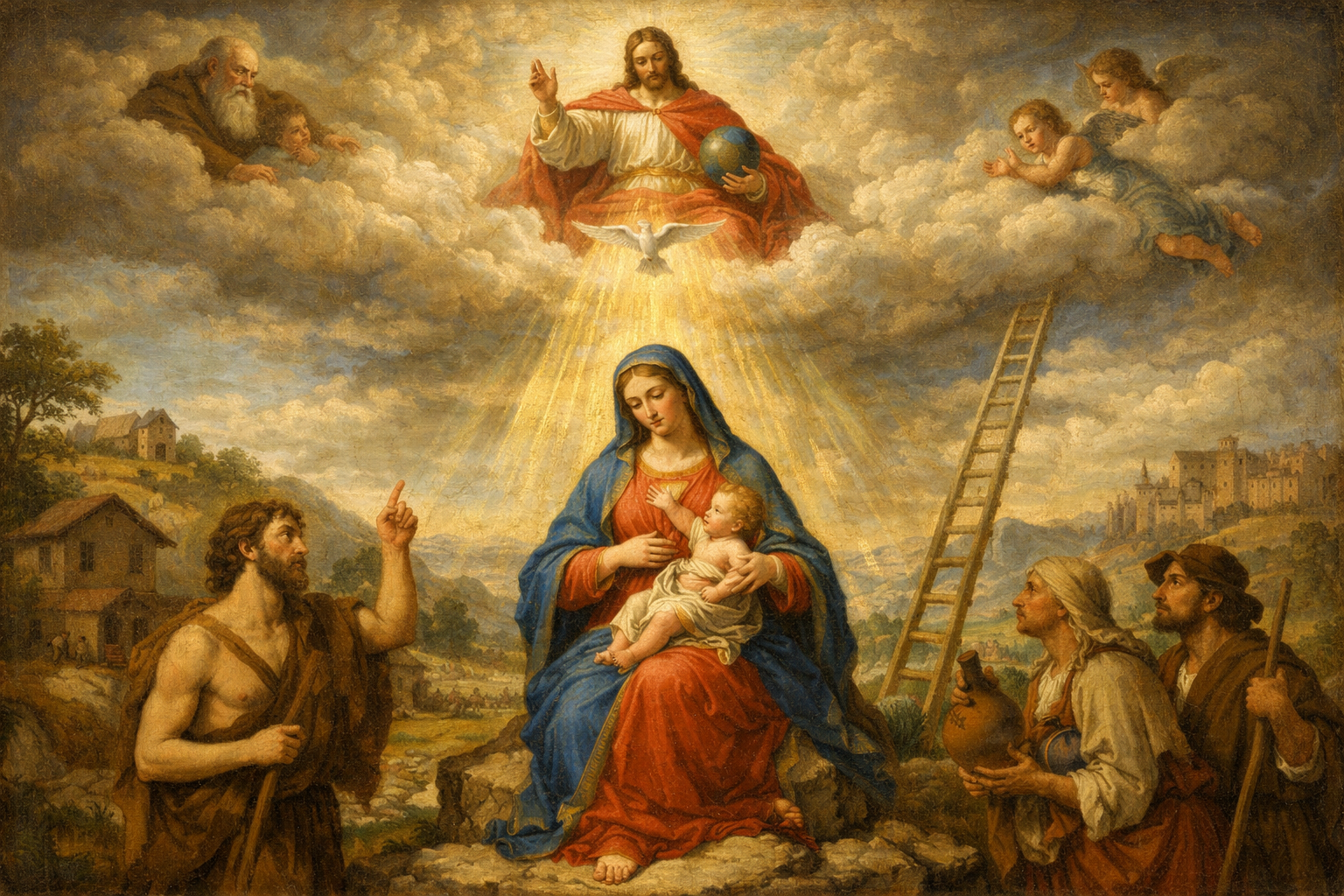
Qui de sursum venit supra omnes est.
Jn 3:31
The Johannine testimony that the liturgy offers us on this Thursday of the Second Week of Easter presents one of the loftiest Christologies of the Fourth Gospel: the one who comes from above is above all. The discourse of John the Baptist draws a radical ontological distinction between the Son who “comes from above” and all the others, who are “of the earth”. This Word “come from on high”, however, took flesh from a creature “of the earth”, and that creature is Mary. Meditating on this text invites us to explore the meeting point between the Eternal and the temporal that took place in the womb of a woman of Galilee, and to understand how Mary, a creature ek tēs gēs, became the dwelling place of the anōthen erchomenos.
I. The Logic of the “One Who Comes from on High”
The expression ho anōthen erchomenos, “the one who comes from above”, deliberately contrasts with ho ek tēs gēs, “the one who is of the earth”. John constructs an ontological antithesis that runs through his whole Gospel: there are two levels of being, two modes of existence, two radically distinct origins. The Son belongs, by nature, to the level of the “above”, to the plane of the Father, of eternity, of uncreated life. Human beings belong, by nature, to the plane of the “earth”, to the world of the creature, of time, of mortality. This distinction is not a poetic metaphor: it is a statement about the real ontological difference between the Creator and the creature, between the eternal Word and historical existence.
Classical mariology, in the line of Thomas Aquinas and Bonaventure, reflected on how Mary is situated within this fundamental antithesis. She is, like all human beings, ek tēs gēs, a creature, a being of historical and temporal origin. But by the singular grace of the Immaculate Conception and by the divine maternity, she is closer to the “above” than any other creature. The Second Vatican Council affirms that she “is far above all angels and all men” (Lumen Gentium, no. 53), without thereby losing her essential creaturely condition. Mary’s “closeness to the above” does not raise her nature to divinity, but expresses the fullness of grace that prepares her to be the Mother of the eternal Son.
This tension between the “of the earth” and the “from on high” is manifested in a particularly acute way in the mystery of the Incarnation. The Word who “comes from above” chose to become “of the earth” precisely through Mary. His descent to the level of the creature does not diminish Him. Rather, it raises up the creature through whom He passes. Mary, who was “of the earth”, becomes, through the divine maternity, the unique place where the “above” and the “earth” meet, the only creature who can at once be a creaturely being and the dwelling of the Son of God. In this sense, Louis Bouyer called Mary “the meeting point between heaven and earth”, a metaphor that resonates with the ancient image of “Jacob’s ladder” (Gen 28:12) that the Fathers applied to the Mother of the Lord.
The theological beauty of this situation was grasped with particular depth by Hans Urs von Balthasar in Sponsa Verbi: the Word who “was in the beginning with God” (Jn 1:1) and who is “above all” dwelt in the womb of a creature, not as a contradiction of His “being from above”, but as the supreme expression of the kenotic love that is able to descend without ceasing to be. The “one come from on high” does not lose His altitude in descending: He transforms the creature who welcomes Him into a “dwelling of the Most High”. Mary is thus the living realization of the christological paradox that Jn 3:31 states.
II. Mary as the Perfect “Hearer” of the Testimony
Jn 3:32 says that “no one receives His testimony”, a radical statement about human unbelief before divine revelation. The following verse qualifies this: “whoever has received His testimony has set his seal that God is truthful” (Jn 3:33). The Marian tradition responds to this text with a luminous and decisive exception: Mary is the creature who fully received the testimony of the Son. Her faith was not a partial faith, conditioned by favorable circumstances or by direct vision. It was a total faith, kept even in the darkest and most sorrowful hours. She is the “blessed one who believed” (Lk 1:45), the title that her cousin Elizabeth bestows on her and that the Gospel takes care to record.
Karl Rahner, in a celebrated mariological essay of 1962, called Mary “the faithful one par excellence”, the one who not only hears the Word but welcomes Him with a total and active faith. Mary’s receptivity is not passivity: it is the most active of responses, because it involves the total investment of freedom, intelligence, and love in the acceptance of the divine testimony. To receive the testimony of God, as Jn 3:32-33 implies, is not a passive act of registering information: it is an act of self-surrender that transforms the receiver into a witness of what he has received. Mary did not only receive. She herself became a witness, transmitting the testimony she had received to the world through her motherhood.
Mary’s experience as “hearer of the Word” was the central theme of influential theological reflections, taken up by Hans Urs von Balthasar in Mary and the Church. For Balthasar, Mary’s receptivity to the Word is the model of all theology: before speaking about God, one must listen to God. And Mary, who listened to the Word in her womb for nine months before seeing Him with her eyes, is the archetype of the theologian who meditates before proclaiming, who remembers before teaching. Mariology is, in this sense, a school of theological listening, a reminder that the starting point of reflection about God is always receptive faith, and not autonomous speculation.
There is a remarkable progression in Mary’s “listening” throughout the Gospels: she listens to the angel at the Annunciation. She listens to the greeting of Elizabeth, who proclaims her “blessed because she believed” (Lk 1:45). She listens to the words of Simeon at the Presentation, which announce what is not easy to hear (Lk 2:34-35). She hears the young Jesus explain that He must “be about His Father’s affairs” (Lk 2:49). She hears the Son say at Cana words that sound like a refusal and finds in them an invitation. This progression in listening is the journey of a believer who grows in faith: not because her initial faith was insufficient, but because the mystery she welcomed is infinitely richer than any finite understanding can exhaust at once.
III. The Spirit “Without Measure” and the Fullness of Mary
Jn 3:34 affirms that God “does not give the Spirit by measure” to the One He sends. The Son receives the Spirit without limitation, ou ek metrou, “not from a measure”. This affirmation about the pneumatological fullness of the Son has direct mariological resonances. The grace granted to Mary, the grace that the angel designated with the participle Kecharitōmenē, “she who has been filled with grace” (Lk 1:28), is, in its creaturely order, a participation in the logic of the “without measure”: Mary did not receive a partial or limited grace, but a grace proportionate to her unique vocation. Thomas Aquinas stated the principle: grace is always proportionate to the mission. And Mary’s mission is the greatest that a creature can have.
The Annunciation confirmed this fullness in a concrete and Trinitarian way: “the Holy Spirit will come upon you and the power of the Most High will overshadow you” (Lk 1:35). The action of the Holy Spirit upon Mary in the Incarnation is described with two verbs that evoke at once creation (“the Spirit that hovered over the waters”, Gen 1:2) and the presence of God in the Tabernacle (“the cloud that covered it”, Ex 40:35). Mary is the “new tabernacle” where the Spirit dwells in a singular way, the new ark of the covenant that carries the Word into the world. This typological identification, developed by the Fathers and by the liturgy, expresses the density of the Spirit’s indwelling in Mary.
The relationship between Mary and the Holy Spirit is not limited to the Annunciation. At the Visitation, “Elizabeth was filled with the Holy Spirit” when she heard Mary’s greeting (Lk 1:41): the presence of Mary transmits the Spirit, because she bears Him within herself in a singular way. In the Upper Room at Pentecost (Acts 2:1-4), Mary is present when the Spirit descends upon the newborn Church. Her presence is not accidental: she is the link between the Spirit of the Incarnation and the Spirit of Pentecost, the human guarantor of the continuity between the two great moments of the outpouring of the Spirit in the history of salvation. Yves Congar emphasizes in Je crois en l’Esprit Saint that Mary is the creature most “habitée” by the Spirit after Christ, the “bride” of the Spirit in the sense of the most intimate creaturely cooperation with the divine Person.
Pentecost was not for Mary a radical novelty: it was the confirmation and the ecclesial extension of what she had been living since the Annunciation. The difference between the Annunciation and Pentecost, as regards Mary, is the difference between private reception and public reception: at the Annunciation, the Spirit came upon Mary for the Son. At Pentecost, the Spirit came upon Mary and the Church for the disciples. The Mary of Pentecost is the same Mary of the Annunciation, but her experience of the Spirit now expands to embrace the whole apostolic community, of which she is the maternal and praying heart.
IV. The Risen “One Who Comes from on High”
In the paschal season, the affirmation “comes from above” takes on a new and decisive dimension: the Risen One not only came from on high in the Incarnation, but returned on high in the Ascension, and goes there before His disciples. “I go to prepare a place for you. And when I have gone and have prepared a place for you, I will come again and will take you with Me, so that where I am, you also may be” (Jn 14:2-3). Mary, who welcomed the Son in the first “coming from on high”, awaits and intercedes for His definitive coming in the hearts of all who are still on the way.
Eschatological mariology, developed by authors such as Stefano De Fiores and François-Marie Léthel, sees in Mary the figure of the Church in her dimension of waiting and of hope: she who witnessed the first coming is also the perfect icon of the expectation of the final coming. The Assumption of Mary, read in this Johannine key, is the anticipation of the eschatological fullness that awaits the whole Church. The “one come from above” drew the Mother “upward”, and this ascensional movement of Mary is the most concrete sign that the destiny of the disciples is to share in the “above” from which the Son came and to which He returned.
Mary’s presence in the Upper Room between the Ascension and Pentecost (Acts 1:14) is a theologically rich image of this tension between the “already” and the “not yet” that characterizes all Christian existence. Mary, who saw the Son ascend “on high”, awaits the full accomplishment of this ascent in all the members of the Body of Christ. Her prayer in the Upper Room is not nostalgia for the absent Son. It is active intercession that the Spirit may come and that the Church may grow up to the “above” from which the Son promised that no one would be snatched away (Jn 10:28-29).
Jn 3:36 ends with a note of urgency that concentrates the whole gravity of the text: “whoever believes in the Son has eternal life. Whoever does not believe in the Son will not see life, but the wrath of God remains upon him”. This urgency finds in Mary its most effective antidote: she who is the Mother of all the baptized intercedes that no child may be lost, that all may “believe in the Son” and have the eternal life that He came to bring. The spiritual motherhood of Mary is, in the final analysis, an intercession for universal salvation, in continuity with the will of the Father that Jn 3:16 expresses: not the condemnation, but the salvation of the world.
The Word who came from on high took flesh in Mary and opened the way of return on high for all who believe. May the faith of Mary, who received the testimony more fully than any other creature, accompany and sustain us on this way.
Postgraduate Program in Mariology
Would you like to deepen your formation in Mariology? Discover the Postgraduate Program in Mariology of Locus Mariologicus – an academic formation that unites theological rigor, spiritual life, and the living tradition of the Church.
Would you like to study Mariology seriously?
This article is born of the works in the library of Locus Mariologicus. The Postgraduate Program in Mariology takes you to that same source, with academic guidance: Scripture, the Fathers of the Church, and the Magisterium, from the first dogma to contemporary questions.




Responses