Your Father and I, union and fatherhood

“Your Father and I”: Mary, Joseph and fatherhood in the Holy Family
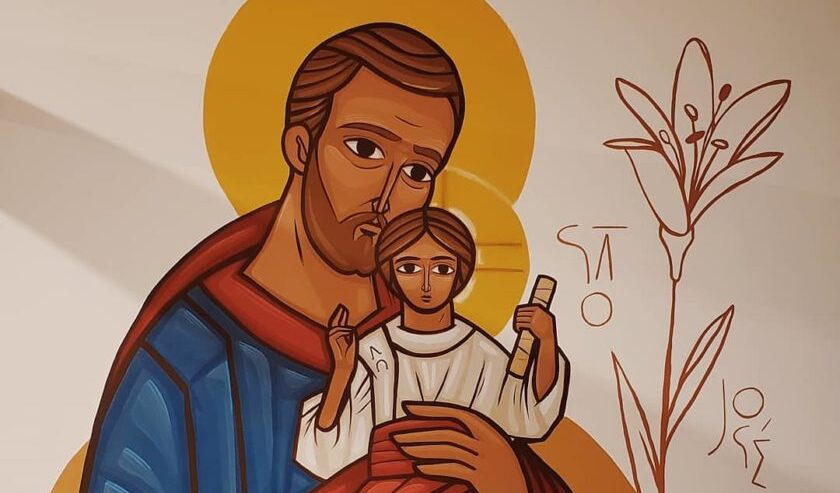
When Mary and Joseph find Jesus in the temple, and the Mother asks Him the question: “Son, why have You done this to us?”, immediately motivating it by the sorrow that His absence caused them, she refers to Joseph as “father”: “Behold, Your father and I were searching for You in anguish” (Lk 2:48). It was Saint Luke himself who recounted that Simeon “came into the temple. And while the parents were bringing the child Jesus there” (Lk 2:27). “The father and the mother of Jesus marveled” (Lk 2:33). “His parents went every year to Jerusalem” (Lk 2:41). Not a clarification about the account of Joseph, not an adjective (legal, adoptive) specifying his role. In fact, once the virginal conception of Mary by the work of the Holy Spirit had been clearly affirmed, it was not necessary to insist on it every time Joseph is mentioned in relation to Jesus.
There is, however, another reason. Joseph was the father of Jesus in every respect. If a civil registry had existed at that time, Joseph would have appeared there as the father and, according to the concrete social organization of the Jewish people and their customs (and certainly not only by the exclusive will of men), the legal father was the one who transmitted rights to children. There is, therefore, something more than a biological fatherhood. The Virgin Mary, addressing Jesus, acknowledged it thus: “Your father and I”.
When Saint Augustine wrote about the fatherhood of Joseph (Sermon 51), he posed the question in these terms: Jesus “was born of a virgin without the seed of a husband. And yet He kept the two of them as parents. How do we prove this? It was Mary who said: Your father and I, in anguish, were looking for You”. “She did not hold to the dignity of her womb, but to the conjugal hierarchy”. For the husband is the head of his wife (Eph 5:23). That, in spite of this, it was the Virgin, and not Joseph, who turned to Jesus is explained by the particular and unique bond that united the Mother to the Son. It was not, strictly speaking, Joseph’s part to ask for reasons, but to work to protect them. He, so silent even when he would have had every right to ask questions, would perhaps have failed in his custom, when what had to be done was rather the responsibility of Mary, who, being more closely united to Jesus, could for that very reason give the right tone to the words. This does not remove the fact that it was to him, the head of the family, that God was transmitting the choices to be adopted at every moment in order to protect the Child and the Mother.
Jesus did not contradict the name of “Father” that Mary gave to Joseph. In fact, there is not only biological fatherhood, and indeed that kind of fatherhood is often of a lower level in relation to the others. The grace infused into man by baptism raises him to the supernatural order and makes him an adoptive son of God and an heir of His glory. There is no relation to biology, yet the fatherhood of God toward the baptized is not only superior to physical fatherhood, but even more real and certainly more lasting. As for Saint Joseph, therefore, it is true that our faith teaches us that he was not a father according to the flesh, but this is not the only fatherhood.
Sometimes, wishing to form an idea of God’s fatherhood in relation to the baptized, it can happen that we think of the essence of human fatherhood and then try to apply that image to God. But it is a mistake. The reality is exactly the opposite. We cannot really understand what human fatherhood is until we understand (as far as our imperfect faculties can) what God is for us as Father. He is the model, the original reference: as Saint Paul revealed to us (Eph 3:14-15), all fatherhood proceeds from God, who is true and proper fatherhood. The other, that of men, is a will of God, a way chosen by Him to bring new lives into the world. He could have opted for a thousand other procedures with the same efficacy. God associates a man and a woman with His creative power as collaborators in what concerns the body, and places His trust in them so that the education of the new being may be carried out in keeping with his condition as a son of God, disposing him to inherit glory. For this reason Saint Augustine could write about Joseph: “Whoever says, therefore: ‘He must not be called father, because he did not have him as other fathers do’, places the essence of fatherhood in lust rather than in the affection of charity. But he lived the fatherhood of the heart better than anyone else lived that of the flesh. Joseph was the husband of Mary, without any carnal bond, only by the bond of matrimony. Precisely for this reason it was possible to say that he was the father of Christ, who was born of his own wife, with far more reason than if he had simply adopted Him”.
It is therefore very clear that the expression adoptive father, applied to Joseph in relation to Jesus, is very tenuous, although much clearer than the appellation legal father. Joseph does not consider the Son of his wife Mary as a stranger to be adopted, but as the fruit of a virginity that is united to his own, and that is the peculiar good of his marriage with Mary. For Saint Augustine, therefore, Joseph was a true husband and father, and not to the detriment of virginity, but precisely through it and through Mary, his wife.
The force of the argument is not hard to prove. To what extent can a man who gives his seed to fertilize a woman he does not know be called the father of the child she conceives and brings into the world? On the other hand, it is clear that if someone, without having begotten him, adopts a child abandoned in an orphanage, and surrounds him with care, educates him and works for him, and contributes to the formation of a man, not sparing his love, he is more the father of that child than the one who, although having begotten him (perhaps without wanting to), wanted nothing to do with him. No one becomes a father by the simple fact that a woman has become pregnant. To base fatherhood on the biological fact alone is to have a simplistic conception. To be a father is much more.
“The birth of Jesus in Bethlehem gave rise to this unique and exceptional Family in the history of humanity. In this family the Son of God, conceived and born of the Virgin Mother, came into the world, grew up and was educated, and at the same time was entrusted, from the beginning, to the authentically paternal care of Joseph, craftsman of Nazareth, who before the Jewish law was the husband of Mary, and before the Holy Spirit was her worthy husband and the guardian, truly paternal, of the maternal mystery of his Spouse” (John Paul II). Authentic paternal care, care that expresses the love of a father for his son. Joseph loved Jesus as a son, received through his wife, although He came not “of blood, nor of the will of the flesh, nor of the will of man” (Jn 1:13), but of the will of God. Turning to Jesus, we see Saint Joseph as “the holy man who adopted Him, or rather, to whom God gave Himself as a son”. It was the Son of God Himself who chose him as His father.
Joseph carried out his role as father by protecting Jesus from Herod and then by preserving Him from the potential danger represented by Archelaus. That is why he left his native land, went to foreign lands, changed his plan as many times as was necessary. He subordinated his life to the good of Jesus.
We too, men of the third millennium of the Christian era, can learn the lesson that Joseph suggests to us across a distance of two thousand years. With regard to children, first of all, self-denial. To protect Jesus, to save Him from a certain and deadly risk, Joseph abandoned the city in which he had settled and took his family to a foreign land, to begin again.
The first duty of a father, of a head of a family, is, quite evidently, to protect his loved ones and to preserve them from imminent dangers. People are more important than things; the wife and the children are more important than social and economic position and not work itself. The concern of parents for their children will lead them to forestall dangers, without forgetting that those of the moral order are more serious and have worse consequences than the risks their health may face.
Joseph took care to bring his son to the temple in order to fulfill the precept of the law. He worked to have Him circumcised in due time, presented Him in the temple and redeemed Him. Whoever does not see to baptizing his child without unnecessary delay does not respect the paternal role, because he arbitrarily deprives him of an immense good.
There are those who cite, to justify their refusal, a long-winded motive whose seriousness is hard to accept, namely respect for the child’s freedom: that it will be the child who spontaneously asks for baptism, if he so wishes, when he grows up? Almost a century ago, Chesterton was already meeting the petulance of a young mother: “I do not want to teach my child any religion. I do not want to influence him. I want him to choose for himself when he grows up”. The writer’s answer is ironic: why apply that principle only to religion and not to all the other fields? A truly striking incongruity, a symptom not so much of respect for freedom as of little common sense and considerable willfulness, excusable only as an evident manifestation of ignorance.
To go deeper into the mystery of the Holy Family and the role of Mary and Joseph in the history of salvation, consult the encyclical Redemptoris Mater by Saint John Paul II.
Deepen your studies: explore Mariology, Marian Theology, Marian apparitions and the Postgraduate Program in Mariology.
Postgraduate Program in Mariology
Would you like to deepen your formation in Mariology? Discover the Postgraduate Program in Mariology of Locus Mariologicus – an academic formation that unites theological rigor, spiritual life and the living tradition of the Church.





Responses